It takes more than desire to achieve sustainable success in today’s operationally complicated business environment. It requires accuracy, transparency, automation, and departmental alignment. Disjointed systems produce inefficiencies that impede growth as businesses expand across several sites, product categories, and clientele groups.
ERP Software becomes crucial in situations like these.
Finance, operations, supply chain, human resources, procurement, and customer data are all combined into a single system by enterprise resource planning platforms. Leadership teams are given real-time control over performance, expenses, and growth levers rather of having to manage disjointed workflows.
ERP Software implementation is a strategic shift for businesses who are focused on growth, not just an IT choice.
Understanding ERP Software in the Enterprise Context
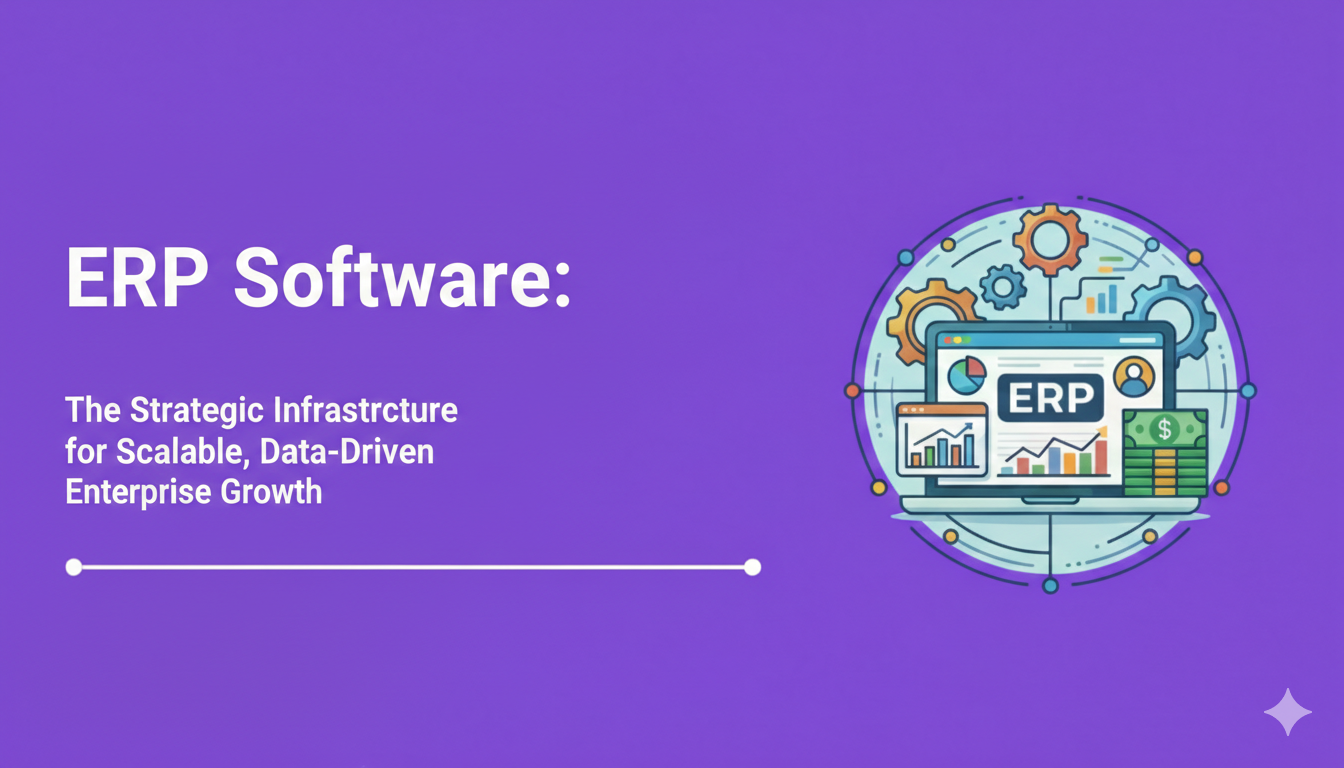
ERP Software unifies important corporate operations into a single digital environment at its heart. Organizations use a single source of truth for accounting, inventory, payroll, and reporting instead of depending on separate tools.
Modules for the following are frequently included in modern ERP Software:
- Management of finances
- Operations of the supply chain
- Purchasing and managing vendors
- supervision of manufacturing
- Management of human capita
- Accounting for projects
- Observation of compliance and risk
- Reports and business intelligence
ERP Software provides structural consistency while preserving growth flexibility for businesses working in multi-entity or multi-state situations.
Why Growth-Focused Businesses Outgrow Legacy Systems
Spreadsheets, department-specific platforms, and independent accounting applications are common starting points for businesses. Although initially operational, these systems ultimately result in bottlenecks:
- Data reconciliation by hand
- Delays in reporting
- Limited visibility for forecasting
- Mismatches in inventory
- Risks of noncompliance
- Redundancies in operations
Complexity increases with revenue. Leadership lacks the cohesive understanding required for strategic growth without ERP Software.
Integrated infrastructure is necessary for enterprise growth.
The Strategic Value of ERP Software
Beyond operational effectiveness, ERP Software adds value. It fortifies the fundamental tenets that support long-term growth:
- Financial Control and Predictability
To inform their decisions, executive teams need up-to-date, precise financial data. General Ledger Updates Are Automated With ERP Software
- Consolidation of multiple entities
- Cash flow visibility in real time
- Monitoring revenue recognition
- Monitoring of budget variances
Organizations may better understand their cost centers, capital allocation opportunities, and profitability drivers with centralized reporting.
- Operational Alignment Across Departments
When departments work in silos, growth is unsuccessful. By integrating workflows, ERP Software reduces fragmentation.
For instance:
- Inventory levels are automatically updated by sales orders.
- Production scheduling and procurement are in sync.
- Payroll and project expense tracking are compatible.
- Finance instantly reflects business transactions.
This degree of integration enhances cross-functional accountability, speeds up procedures, and lowers errors.
- Scalable Infrastructure for Expansion
Flexible systems are necessary for entering new markets, setting up distribution facilities, or purchasing subsidiaries.
ERP Software is compatible with
- Management of many locations
- Transactions involving multiple currencies
- Across-jurisdictional regulatory compliance
- Accounting between companies
- Access controls based on roles
Scalability makes ensuring that expanding doesn’t necessitate starting over with new systems.
Core Modules That Drive Enterprise Performance
Certain modules regularly produce quantifiable results, despite the fact that ERP Software configurations differ per industry.
The financial core makes it possible for:
- Automated receivables and payables
- Management of tax compliance
- Tracking of fixed assets
- Reporting on profits and losses in real time
- Audit-ready records
Investor and executive confidence are bolstered by financial visibility.
- Supply Chain and Inventory Control
Precision is necessary for operational growth. ERP Software improves the effectiveness of the supply chain by
- Forecasting demand
- Points of automated reorder
- Analytics for vendor performance
- Optimization of warehouses
- Inventory tracking through serialization
Businesses lower carrying expenses without sacrificing service dependability.
Workforce management is more complicated as employment increases. ERP Software unifies:
- Processing payroll
- Administration of benefits
- Monitoring performance
- Analytics for the workforce
- Documentation of compliance
Strategic workforce planning is supported by integrated HR data.
- Business Intelligence and Reporting
Businesses that are data-driven fare better than their rivals. Dashboards and analytics tools included with ERP Software include:
- Make KPIs visible
- Turn on trend forecasting.
- Determine whether margin erosion is occurring.
- Find inefficiencies in operations
- Encourage the use of scenario modeling
Leadership acts proactively rather than reactively.
ERP Software and Digital Transformation
Initiatives for digital transformation frequently fail because of disjointed systems. Automation, AI integration, and advanced analytics are supported by ERP Software, which serves as the digital foundation.
Enterprises get the following results when ERP Software is integrated with CRM platforms, eCommerce systems, and business intelligence tools:
- Data continuity from beginning to finish
- Workflows that are automated
- Decreased manual involvement
- Increased accuracy in forecasting
Faster time-to-market and operational agility are the outcomes.
Implementation Strategy for Long-Term Success
A business transformation occurs when ERP Software is implemented, not just a technical upgrade. Sustainable outcomes are guaranteed by a planned rollout.
Phase 1: Strategic Assessment
- Analyze the operational inefficiencies that exist now.
- Determine any gaps in integration.
- Establish quantifiable goals.
- Executive stakeholders should align
Uncertainty and scope creep are avoided with well-defined objectives.
Phase 2: System Selection
ERP Software selection is influenced by:
- Industry-specific specifications
- Requirements for scalability
- Flexibility in customization
- Capabilities for integration
- Standards for compliance
Long-term expansion strategy should be in line with enterprise-grade solutions.
Phase 3: Process Optimization Before Automation
Strong processes should be strengthened by automation, not broken ones. Prior to deployment:
- Streamline processes
- Get rid of redundant information
- Describe the hierarchies of approval.
- Make reporting structures more clear.
ERP Software efficacy is increased by optimized procedures.
Phase 4: Data Migration and Integration
Data integrity is essential. Plans for migration must guarantee:
- Transferring historical data accurately
- Master data structures that are clean
- Validation of secure data
- Smooth interfaces with third parties
System trust is increased by consistent data.
Phase 5: Training and Change Management
Adoption of technology is a human endeavor. Companies need to:
- Offer training tailored to a department.
- Create internal champions for ERP.
- Promote feedback loops
- Strengthen responsibility
Teams who recognize the value of ERP Software adopt it more quickly.
Common Challenges and How to Mitigate Them
ERP Software initiatives need to be managed with discipline even though they are transformational.
Resistance to Change
Workers could be afraid of complexity or interruptions to their jobs. Training and open communication reduce resistance.
Underestimating Implementation Time
Timelines that are structured are necessary for enterprise deployments. Stability is ensured via realistic scheduling.
Over-Customization
Upgrades are made more difficult by excessive customization. Long-term flexibility is maintained by strategic configuration.
Inadequate Leadership Involvement
Executive support is essential. ERP Software must be in line with business objectives as well as IT goals.
ERP Software for Multi-Entity and Complex Enterprises
Organizations that prioritize growth frequently function across several legal entities, divisions, and geographical areas. ERP Software gives you:
- Financial statements that are combined
- Management of intercompany transactions
- Centralized purchasing
- Integrated supervision of compliance
- Dashboards for enterprise-wide KPIs
Structural clarity is achieved by complex companies without compromising agility.
The Competitive Advantage of Integrated Intelligence
Leadership in competitive markets is determined by speed and intelligence. ERP Software gives you the following advantages:
- Activating executive dashboards in real time
- assisting with predictive analytics
- Finding potential for margin optimization
- Enhancing the management of working capital
Reactive management gives way to predictive strategy in organizations.
ERP Software and Regulatory Compliance
The standards for compliance are always changing. Accurate reporting and documentation must be maintained by enterprise systems.
ERP Software improves compliance by
- Automated tax computations
- Audit traces
- Permissions for security depending on roles
- Protocols for data encryption
- Automation of regulatory reporting
Long-term sustainability is directly supported by risk reduction.
Cloud-Based ERP Software: The Future of Enterprise Operations
Cloud-based ERP Software is being used more and more by modern businesses for:
- Accessible remotely
- Infrastructure that can grow
- Updates that happen automatically
- Lower hardware expenses
- Higher cybersecurity requirements
Without compromising performance, cloud platforms provide multi-location operations and distributed teams.
Financial Planning and Forecasting with ERP Software
Dynamic modeling is necessary for strategic financial planning. ERP Software makes it possible to
- Forecasts that roll
- Planning scenarios
- Estimates of revenue
- Modeling expenses
- Alignment of the budget
With less risk exposure and more confidence, executives can assess growth prospects.
Aligning ERP Software with Long-Term Growth Strategy
Investments in technology must complement corporate goals. ERP Software ought to enable:
- Growth of the market
- Diversification of products
- Integration of acquisition
- Scaling the workforce
- Automation of operations
ERP Software transforms from a support system into a catalyst for long-term growth when strategically aligned.
Building an Enterprise Culture Around Data Discipline
Deployment is only one aspect of successful implementation. Companies need to foster:
- Accountability for data accuracy
- Initiatives for continuous improvement
- Interdepartmental cooperation
- Thinking with an innovative mindset
In settings dedicated to operational excellence, ERP Software performs best.
Final Thoughts: ERP Software as a Growth Multiplier
More is needed for sustainable business growth than just desire. It needs financial control, automation, integration, and visibility. ERP Software offers the structural framework necessary for growth without operational instability.
ERP Software enables:
- Clarity of finances
- Alignment of operations
- Infrastructure that can grow
- Leadership based on data
- Assurance of compliance
- Prolonged financial success
Businesses that invest in integrated systems perform better than those that use disjointed technologies in a business environment that is becoming more and more competitive.
The strategic foundation of contemporary business success is ERP Software, which is not just a technological advancement.
ERP Software converts operational complexity into competitive advantage when it is deployed carefully and in line with long-term goals, enabling businesses to grow with assurance and sustainability in dynamic marketplaces.
1. What is ERP in software?
In software, ERP stands for an integrated system that unifies supply chain, HR, operations, and finance on a single platform. ERP Software is described in our blog as a strategic architecture that offers enterprise-level control, real-time visibility, and scalable growth.
2. What are examples of ERP software?
Enterprise platforms that combine supply chain management, operations, and finance, such as SAP, Oracle, and Microsoft Dynamics, are examples of ERP software. ERP Software is defined in our blog as a centralized system that centralizes essential business operations to facilitate data-driven, scalable growth.
3.What are the three types of ERP?
The implementation and infrastructure models of the three ERP types—on-premise, cloud-based, and hybrid—vary. For growth-oriented, operationally complicated businesses, ERP Software, particularly cloud-based systems, is positioned in our blog as the most scalable choice.
4. Is ERP B2B or B2C?
ERP is mostly utilized in business-to-business (B2B) settings since it handles intricate company processes including supply chain management, finance, and procurement. For growth-oriented businesses functioning in operationally complex, multi-entity B2B ecosystems, ERP Software is positioned in our blog.
5.What type of businesses use ERP?
ERP is frequently used by mid-sized to big businesses in sectors like manufacturing, distribution, retail, healthcare, and professional services. ERP Software, according to our blog, is made for operationally sophisticated, growth-oriented companies that need centralized control and scalable infrastructure.



 Get Started