In the increasingly complicated world in which modern firms operate, long-term success is determined by operational effectiveness, financial visibility, and strategic adaptability. Scalability is limited and inefficiencies are produced when finance, inventories, procurement, human resources, and sales are managed using disjointed software. Centralized control becomes increasingly important as businesses grow in size. Here, integrated enterprise management relies heavily on ERP systems.
ERP solutions integrate key company processes into a single platform rather than operating as stand-alone tools. They facilitate cross-departmental communication, optimize workflows, and offer real-time data visibility. By transforming daily operations and executive decision-making, the implementation of structured ERP systems is a strategic investment for businesses looking for operational stability and sustainable growth.
Understanding ERP Systems in Today’s Business Environment
The purpose of enterprise resource planning systems is to centralize key corporate operations. By linking departments via a common database, ERP systems break down data silos and guarantee that information moves freely throughout the company.
Leadership obtains a consistent and accurate operational view when financial records reflect real-time transactions and sales orders instantly update inventory levels. This integration facilitates well-informed strategic decision-making, decreases effort duplication, and enhances coordination.
Profitability is determined by operational visibility in marketplaces that are becoming more and more competitive. By combining data, procedures, and performance indicators into a single, regulated environment, ERP solutions offer that visibility.
The Growing Need for Operational Control
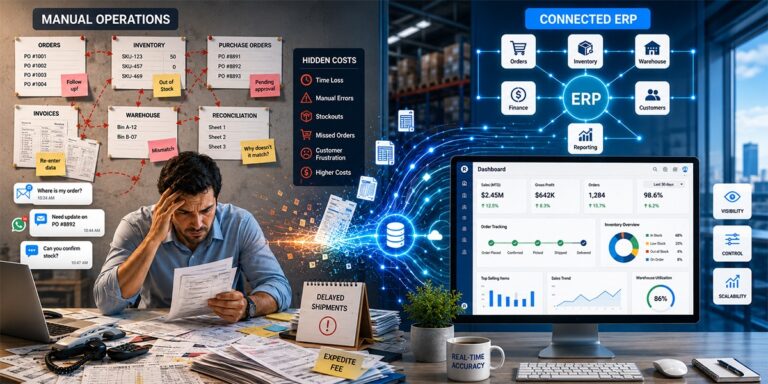
Operational difficulties increase as companies grow. Margin erosion can occur rapidly due to inventory misalignment, incorrect data, delayed reporting, and manual reconciliation. In the absence of organized supervision, complexity becomes expensive.
Contemporary businesses must deal with:
- Growing product lines
- Operations at multiple locations
- Management of a distributed workforce
- Raising the bar for compliance
- Growing expectations from customers
ERP solutions automate repetitive work and standardize procedures to address these issues. Organizations work inside a single control system that improves accuracy and accountability rather than depending on spreadsheets or separate programs.
Core Modules That Strengthen Operational Oversight
ERP systems are strong because of their modular design. Every module maintains complete integration with the larger system while supporting a distinct function.
- Financial Management and Reporting
Operational control requires financial transparency. Advanced accounting features offered by ERP systems include:
- Management of general ledgers
- Automation of accounts payable and receivable
- Monitoring and projecting the budget
- Monitoring of tax compliance
- Financial reporting in real time
Organizations can increase decision accuracy and decrease reporting delays by centralizing financial data.
- Supply Chain and Inventory Management
Profitability is directly impacted by inventory visibility. While stockouts undermine consumer confidence, overstocking raises carrying costs. ERP systems provide supply chain coordination and real-time inventory tracking.
Among the operational enhancements are:
- Purchase orders are generated automatically.
- Tools for demand forecasting
- Monitoring of vendor performanc
- Integration of warehouse management
- Synchronization of order fulfillment
These features enable companies to minimize operational disruption and maintain ideal stock levels.
- Human Resource and Workforce Management
As businesses expand, workforce coordination gets more complicated. ERP systems combine performance reviews, benefits administration, payroll processing, and attendance monitoring into a single, organized platform.
Integrated HR modules promote employee productivity and compliance while ensuring that labor expenditures are in line with financial strategy.
- Sales and Customer Management
Accurate order processing and customer data management are essential for revenue performance. ERP systems establish a direct connection between finance and inventory modules and sales operations.
This integration guarantees:
- Correct invoicing and billing
- Order status tracking in real time
- Management of customer accounts
- Analytics of sales performance
Organizations can lower errors and enhance service quality by using synchronized information.
How ERP Systems Improve Decision-Making
Accurate data must be instantly accessible to modern leaders. Reporting after the fact limits flexibility and raises risk. ERP systems offer real-time performance information through consolidated dashboards.
Those who make decisions can keep an eye on:
- Trends in revenue
- Costs of operations
- Rates of inventory turnover
- Metrics of employee productivity
- Patterns of customer demand
Strategic planning shifts from being reactive to proactive with this visibility.
Automation and Workflow Efficiency
Workflows that are done by hand take longer and are more prone to mistakes. Payroll computations, purchase approvals, compliance reporting, and invoicing are just a few of the repetitive tasks that ERP systems automate.
The benefits of automation are quantifiable:
- Decreased overhead in administration
- quicker cycles of transaction
- Reduced rates of errors
- Enhanced responsibility within the organization
Organizations can increase productivity and reallocate resources to growth efforts by decreasing manual intervention.
ERP Systems and Scalability
Growth adds complexity that is too much for simple systems to handle. ERP systems are made to grow with the company, whether that growth takes the form of more locations, a wider range of products, or a higher volume of transactions.
Scalable infrastructure guarantees:
- Regular standardization of processes
- centralized management of several site
- Flexibility with regard to new business concepts
- smooth addition of new modules
Companies that make investments in scalable ERP systems steer clear of expensive system replacements when they grow.
Deployment Models for ERP Systems
Depending on their operational requirements, organizations can use a variety of deployment methodologies to adopt ERP systems.
Internal hosting provides direct control but necessitates specialized IT resources for upkeep and updates.
supplied via safe web infrastructure that permits automatic updates and remote access.
combines cloud flexibility with on-premise control to satisfy specific operating needs.
Depending on the need for scalability, legal constraints, and IT capability, each strategy offers unique benefits.
Implementation Best Practices
ERP system adoption involves meticulous preparation and methodical implementation.
The following are suggested implementation steps:
- Making operational evaluations
- Clearly defining goals and KPIs
- Choosing the right modules
- Data migration and validation
- Offering training to employees
- Workflow testing and optimization
For deployment to go smoothly, cross-departmental cooperation and executive support are essential.
Overcoming Common Implementation Challenges
Even though ERP systems have revolutionary advantages, firms may face difficulties when making the switch.
Typical challenges consist of:
- Opposition to change
- Inconsistencies in the data
- Complexity of integration
- Not enough instruction
- Customization needs were underestimated.
In order to reduce these risks and guarantee long-term success, proactive change management techniques are helpful.
Measuring the Impact of ERP Systems
Continuous improvement is ensured by performance evaluation following implementation.
Among the key performance indicators are:
- Lowering of operating expenses
- Enhanced speed of order processing
- Enhanced accuracy in financial reporting
- Increased turnover of inventories
- Increased client satisfaction
Monitoring these indicators shows the real value that ERP systems provide.
The Future of ERP Systems
The possibilities of enterprise platforms are always being expanded by technological innovation. Predictive modeling, sophisticated analytics, and artificial intelligence are becoming more and more integrated into contemporary ERP systems.
New improvements consist of:
- Forecasting powered by AI
- Automated detection of anomalies
- Benchmarking performance in real time
- Improved accessibility on mobile devices
- Intelligent workflow automation
These developments facilitate data-driven growth plans while fortifying operational control.
Choosing the Right ERP Systems Partner
Maximizing return on investment requires careful provider selection. Organizations ought to assess:
- Experience in the industry
- Capabilities for integration
- Standards for security
- Options for scalability
- Long-term assistance programs
ERP systems are guaranteed to remain flexible as business needs change when working with a trustworthy partner.
Conclusion
Success in modern company is defined by operational control. Manual workflows and fragmented systems pose preventable hazards, decrease productivity, and restrict visibility. ERP systems offer a centralized, integrated framework that unifies sales, personnel management, supply chain, and finance onto a single, unified platform.
Organizations can improve decision-making skills, automate crucial procedures, and obtain real-time knowledge by implementing structured ERP systems. Businesses that put integrated operational control first position themselves for long-term stability and sustainable growth in a setting that is becoming more and more competitive.
1. What is an ERP system example?
A centralized software platform that combines sales, inventory, human resources, and finance into a single, cohesive system is an example of an ERP system.
ERP systems, for example, allow businesses to immediately sync sales orders with real-time financial reports and inventory adjustments.
2. Is ERP a SAP system?
Although SAP is one of the top suppliers of ERP systems used by businesses globally, ERP is not exclusive to SAP.
SAP is a particular provider that offers ERP solutions, although ERP systems generally refer to integrated business management platforms.
3. What is ERP vs CRM?
CRM focuses on customer connections and sales management, whereas ERP manages key corporate activities including finance, inventory, and operations.
While CRM systems increase client interaction and revenue growth, ERP systems optimize internal workflows.
4. What are the three main ERP systems?
SAP, Oracle, and Microsoft Dynamics are the three primary ERP systems that are most well-known in the industry.
These ERP systems offer comprehensive business solutions for supply chain, operations, finance, and personnel management.
5. What are ERP tools?
Accounting, inventories, procurement, and human resources are just a few of the company operations that are managed by ERP tools, which are software programs that run inside ERP systems.
Together, these products give real-time operational visibility and process automation through a centralized platform.








 Get Started