








Every wholesale and distribution business reaches a breaking point. Orders pile up faster than your team can process them. Spreadsheets that once worked for 50 customers start failing at 500. Inventory counts get off by a pallet, and nobody catches it until a buyer calls furious. The warehouse is moving product, but the books don’t match. Sound familiar?
This is exactly the moment when the right ERP workflow stops being a nice-to-have and becomes the foundation your entire operation depends on. For distributors and wholesalers managing complex order volumes, multi-location stock, and layered customer pricing, the way you design and run your processes determines whether your business scales profitably or collapses under its own weight.
This guide breaks down the practical secrets that growing distribution businesses use to build smarter ERP workflows – ones that cut processing time, reduce costly errors, and give operators real visibility into what’s actually happening across their supply chain.
Why Workflow Failures Are Costing Distributors More Than They Realize
Before we get into what works, it’s worth understanding how much broken processes are actually costing you.
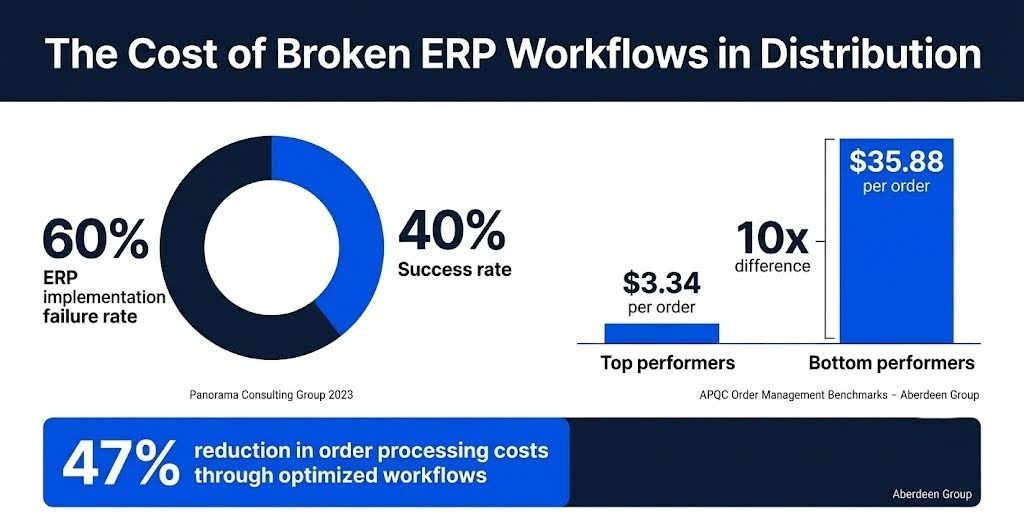
Over 60% of ERP implementations fail to meet their original business objectives – not because the software is bad, but because the underlying ERP workflow design was never properly mapped before going live. [Panorama Consulting Group, 2023 ERP Report – https://www.panoramaconsulting.com/resource-center/erp-report/] Meanwhile, businesses with optimized processes reduce order processing costs by up to 47% compared to those still relying on manual or hybrid systems. [Aberdeen Group, Supply Chain Management Benchmark – https://www.aberdeengroup.com]
For distributors specifically, the pain points cluster around a few critical areas:
- Manual order entry errors that create fulfillment mismatches
- Disconnected inventory data between warehouse and finance
- Slow invoice cycles that delay cash flow
- No real-time visibility into stock levels across locations
Top-performing distribution companies process purchase orders at a cost of $3.34 per order, while bottom performers spend as much as $35.88 per order – a 10x difference driven almost entirely by operational efficiency. [APQC, Order Management Benchmarks – https://www.apqc.org/benchmarks]
Secret #1 – Map Your Order-to-Cash Cycle Before You Automate Anything
The most common mistake distributors make when building an ERP workflow is trying to automate a broken process. Automation amplifies whatever exists – if your order entry process has redundant approval steps, automating it just speeds up the waste.
Start with a full map of your order-to-cash (O2C) cycle. This includes every step from when a buyer places an order to when cash lands in your account:
- Order received (portal, phone, EDI, email)
- Order validated against inventory and credit terms
- Pick/pack instruction sent to warehouse
- Shipment confirmed and tracking generated
- Invoice created and sent
- Payment received and applied to account
Every one of these steps is a potential failure point in a poorly designed system. In distribution businesses that haven’t mapped this cycle, it’s common to find the same data being entered manually three or four separate times – once in the order system, again in warehouse management, again in accounting.
Manual data re-entry errors account for nearly 30% of all order fulfillment discrepancies in wholesale distribution. [Institute for Supply Management (ISM), 2022 Supply Chain Survey – https://www.ismworld.org/supply-management-news-and-reports/] When your ERP workflow connects these steps automatically – order confirmation triggering inventory reservation, fulfillment confirmation triggering invoice generation – that 30% disappears.
The goal isn’t just speed. It’s eliminating the human touchpoints that introduce errors, and giving every team member – from warehouse staff to your AR team – a single source of truth.
Secret #2 – Tiered Customer Pricing Is a Workflow Problem, Not Just a Sales Problem
One of the most underestimated complexity drivers in B2B distribution is customer-specific pricing. Unlike retail, your buyers aren’t all paying the same price. You have contract pricing, volume tiers, promotional agreements, and sometimes individual line-item negotiated rates per SKU per customer.
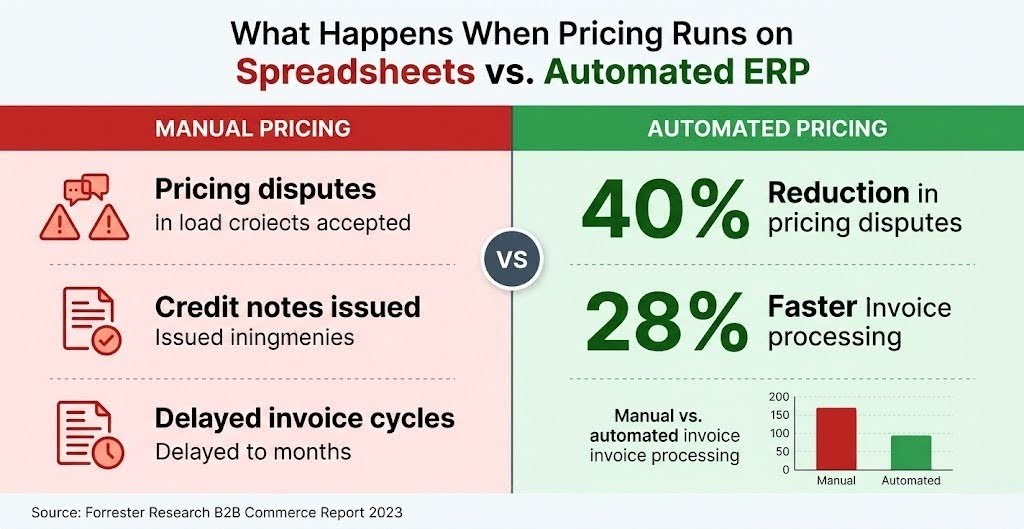
When this pricing data lives in spreadsheets or in the heads of your sales reps, your system breaks every single time an order comes in. Someone has to manually look up the right price, apply it correctly, and hope the invoice matches what the customer was quoted. When it doesn’t, you’re issuing credits, losing margin, and damaging buyer trust.
A properly structured ERP workflow for B2B pricing handles this at the system level. Pricing rules are attached to customer accounts – by tier, by volume threshold, by contract period – and apply automatically at order entry. No lookups. No overrides unless explicitly authorized.
B2B companies that automate pricing within their platform reduce pricing-related disputes by up to 40% and see average invoice processing time drop by 28%. [Forrester Research, B2B Commerce Report, 2023 – https://www.forrester.com/report/b2b-commerce/] For a distributor processing hundreds of orders daily, that translates directly to fewer credits, fewer customer service calls, and more cash collected on time.
The implementation step most teams skip: a full pricing audit before ERP migration. Before your pricing logic goes into the system, every customer account, every contract, and every volume tier needs to be verified and documented. Garbage in, garbage out – the best-designed process in the world can’t compensate for pricing data that was wrong before you imported it.
Secret #3 – Inventory Sync Is the Heartbeat of Distribution Operations
If your ERP workflow doesn’t have real-time, bidirectional inventory sync as its foundation, everything else you build on top of it is unreliable.
This is particularly true for distributors managing multiple warehouses or third-party logistics (3PL) partners. When inventory data lives in separate silos – one system for your East Coast warehouse, another for your 3PL partner, another in your accounting software – your team is constantly reconciling data instead of fulfilling orders.
The results are predictable and expensive. You oversell products you don’t have. You hold safety stock you don’t need because you can’t trust the numbers. You miss fill rate targets with key accounts.
Best-in-class distributors maintain inventory accuracy rates of 98.5% or higher, while median performers sit around 92%. [APQC, Inventory Management Benchmarks, 2023 – https://www.apqc.org/benchmarks] That 6.5-point gap sounds small, but at scale it means thousands of misshipments, write-offs, and strained buyer relationships per year.
The operational architecture that solves this has a few non-negotiable elements:
- Real-time inventory reservation: When an order is placed, inventory is reserved instantly – not at the time of picking. This prevents the double-selling that crushes fulfillment teams.
- Automated reorder points: Rather than relying on warehouse managers to manually flag low stock, the system calculates reorder points based on historical velocity, lead times, and safety stock formulas – and generates purchase orders automatically.
- Cycle count integration: Instead of disruptive annual physical counts, the platform schedules rolling cycle counts, flags variances, and updates records continuously.
- 3PL and EDI connectivity: If you use third-party warehousing, your system needs live feeds from those partners. EDI connections are standard in enterprise distribution, and any modern setup should support 850, 855, 856, and 810 transaction sets at minimum.
Secret #4 – Automate the Paper Trail, Not Just the Picking
Most distributors focus their automation energy on the warehouse floor – faster picking, better routing, barcode scanning. These matter, but the bigger ROI in an ERP workflow often comes from automating the administrative paper trail that surrounds every transaction.
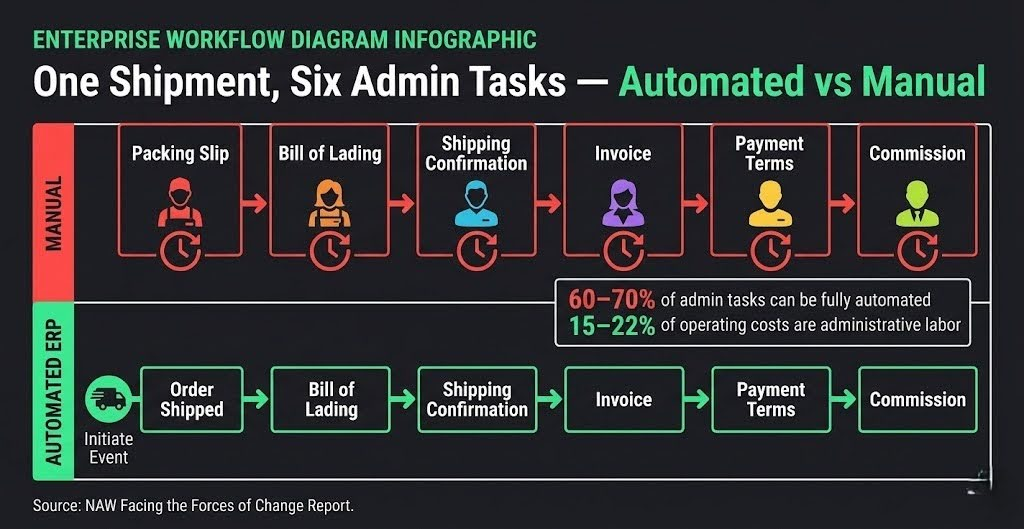
Think about what happens when a single order ships: packing slip generated, bill of lading (BOL) created, shipping confirmation sent to buyer, invoice generated and emailed, payment terms tracked, sales commission calculated. Without workflow automation, each of these is a separate manual task performed by different team members in different systems. With a connected setup, triggering one event cascades through all of them automatically.
Administrative labor costs represent between 15% and 22% of total operating costs for mid-size wholesale distributors. [National Association of Wholesaler-Distributors (NAW), Facing the Forces of Change Report – https://www.naw.org/resources/research-studies/] Automation that eliminates redundant administrative touchpoints is one of the highest-leverage cost reduction strategies available to growing distribution businesses.
For most distributors, 60 to 70% of routine administrative outputs can be fully automated within a properly configured ERP workflow, requiring no human action unless there’s an exception. [NAW, Facing the Forces of Change Report – https://www.naw.org/resources/research-studies/]
Secret #5 – Build Exception Management Into Your Workflow From Day One
Here’s the design principle most ERP consultants don’t emphasize enough: your system should only surface what needs human attention.
A mature ERP workflow doesn’t eliminate human judgment – it directs human judgment to the places where it actually matters. This is called exception management, and it’s what separates distribution businesses running with lean back-office teams from those drowning in operational firefighting.
Exception-based workflow design means:
- Orders that match standard criteria process automatically, without anyone touching them
- Orders that fall outside parameters – credit holds, out-of-stock items, address mismatches, minimum order violations – are flagged and routed to the right person
- Alerts fire proactively when inventory drops below a threshold, when a key account hasn’t ordered in their expected cycle, or when a shipment is delayed
Companies using exception-based management in their supply chain operations reduce expediting costs by 30% and improve on-time delivery performance by 22% compared to those managing operations reactively. [Gartner, Supply Chain Technology Report, 2022 – https://www.gartner.com/en/supply-chain/insights/supply-chain-technology]
The configuration work required to reach this state is upfront-heavy – you have to define what “normal” looks like for every order type, customer segment, and inventory category before the system knows what to flag. But once built, this is the piece of your setup that gives management genuine operational leverage. Instead of reviewing every order, your team reviews the 3% of orders that need attention. Everything else runs.
Secret #6 – Your Operational Data Is a Business Asset, Not a Report
The final and most underutilized element of a high-performing ERP workflow is the data it generates.
Most distributors treat their ERP reports as a backward-looking compliance exercise – pulling monthly numbers to satisfy accounting, checking inventory at quarter end. The businesses that grow fastest treat their operational data as a forward-looking competitive tool.
What does this look like in practice?
- Fill rate analysis by SKU: Which products are you consistently unable to ship on time? Those are your supplier relationship problems, your reorder point miscalculations, or your demand forecasting gaps – all identifiable and fixable through system data.
- Customer order velocity tracking: When a customer’s order frequency drops, your platform should flag it before your sales rep notices. Early churn signals in B2B distribution are almost always visible in order pattern data before they show up in revenue.
- Gross margin by order: Not every order is equally profitable. Factoring in pick complexity, shipping zone, and handling time, some small orders that look fine on the top line are actually margin-negative. Your operational data can surface this, letting you apply minimum order values, small order surcharges, or reprice certain accounts.
Distribution businesses that use their operational data to drive active decision-making – rather than passive reporting – achieve EBITDA improvements of 15 to 25% versus industry peers who don’t. [McKinsey & Company, Wholesale Distribution Analytics, 2023 – https://www.mckinsey.com/industries/distribution] The ERP workflow you’ve already invested in is generating this data right now. The question is whether your business is using it.
Building the Roadmap: Where to Start
If you’re reading this as someone who already has an ERP but suspects their processes are underperforming, here’s the sequence that works for most mid-size distributors:
Month 1–2: Audit and Map Document your current order-to-cash cycle in full. Identify every manual step, every data re-entry point, and every approval gate. Quantify the cost of your current error rate.
Month 3–4: Clean Your Master Data Customer records, pricing tiers, SKU catalog, supplier lead times. Your ERP workflow is only as reliable as the data it operates on. This step is unsexy and skipped constantly. Skip it and your implementation will fail.
Month 5–6: Configure Core Workflows Order management, inventory reservation, and invoice automation come first. These have the highest transaction volume and the fastest ROI.
Month 7–9: Add Exception Management Once core flows are stable, define your exception rules. Build the alerts, approval queues, and escalation paths.
Month 10–12: Connect Analytics Build your reporting dashboards, set up fill rate and velocity tracking, and start using your operational data in business reviews.
Companies with optimized ERP workflows see an average ROI of $7.23 for every dollar invested in ERP improvements, with distribution and wholesale companies among the highest-returning categories. [Nucleus Research, ERP Technology Value Matrix, 2023 – https://nucleusresearch.com/research/single/erp-technology-value-matrix/]

The Real Competitive Advantage in Distribution Isn’t Price – It’s Execution
Buyers don’t leave distributors because of price alone. They leave because of inconsistent fill rates, slow invoicing, pricing errors, and communication breakdowns. Every one of those failure modes lives inside your operational processes.
The distributors who build a reputation for operational reliability – who ship what they promised, when they promised, with accurate documentation – earn preferred vendor status, larger purchase orders, and longer customer relationships. That reputation is built order by order, step by step.
The good news is that the improvements that drive the biggest results aren’t the most technically complex. They’re the most consistently executed. Mapping your processes before automating them. Keeping your master data clean. Building exception management rather than human-touching every transaction. Using your data to see what’s coming rather than just what happened.
These aren’t secrets in the sense that nobody knows them. They’re secrets in the sense that surprisingly few growing distribution businesses actually do them. The ones that do scale faster, operate leaner, and compete on execution in a way that price alone can never match.
- What is an ERP workflow?
An ERP workflow is a structured, automated sequence of steps within an Enterprise Resource Planning system that connects business processes – from order entry and inventory management to invoicing and payment – into one unified flow. It eliminates manual data re-entry, reduces errors, and ensures every team from warehouse to finance operates from a single source of truth.
- How does ERP work step by step?
An ERP system works by connecting every core business function into one centralized platform, flowing data automatically from one step to the next without manual re-entry.
Here’s the step-by-step flow specific to distribution, as outlined in our blog: order is received (via portal, phone, EDI, or email) → validated against inventory and customer credit terms → pick/pack instructions sent to the warehouse → shipment confirmed and tracking generated → invoice automatically created and sent → payment received and applied to the customer account.
- Why do ERP implementations fail?
Over 60% of ERP implementations fail not because of bad software, but because workflow processes were never properly mapped before going live. Automating a broken process only speeds up the waste – design must come before deployment.
- Why is inventory sync so critical?
Without real-time bidirectional inventory sync, distributors oversell stock they don’t have and hold safety stock they don’t need. Best-in-class distributors maintain 98.5% inventory accuracy versus 92% for median performers – a gap that causes thousands of misshipments annually at scale.
- How does ERP data drive business growth?
Distributors who use operational ERP data for active decision-making – not just monthly reporting – achieve 15–25% EBITDA improvements over peers who don’t. Fill rate trends, order velocity drops, and margin-negative orders are all visible inside data your system is already generating today.



 Get Started