







For wholesalers and distributors, the conversation around technology investment has shifted dramatically over the past few years. What used to be a “nice to have” conversation about software upgrades has turned into a survival conversation about visibility, accuracy, and speed. At the center of that conversation sits one system: Supply Chain ERP.
If you run a distribution business, you’ve probably heard the term thrown around in vendor pitches, industry webinars, and LinkedIn posts. But what does the data actually say about adoption, performance, and return on investment heading into 2026? We dug into the numbers, and the picture that emerges is one of an industry at an inflection point – where the gap between businesses running on modern, integrated platforms and those still relying on spreadsheets, disconnected tools, or aging on-premise systems is widening fast.
Below are 15 data-backed insights every wholesale and distribution leader should understand before making their next technology decision – along with what each one practically means for your day-to-day operations.
1. Distribution Is One of the Most ERP-Saturated Industries in the World
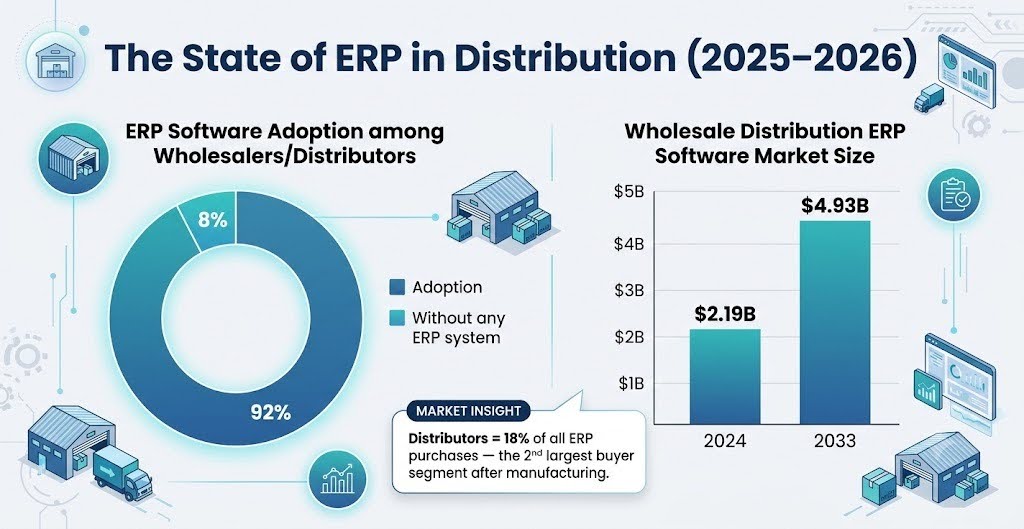
Wholesale distribution has quietly become one of the most technology-dependent sectors in the business world. Industry data shows that roughly 92% of wholesalers and distributors are already using some form of enterprise resource planning software, making this one of the highest adoption rates of any industry segment [BlueLink ERP Statistics, 2025]. That’s not a coincidence – distribution businesses live and die by inventory accuracy, order fulfillment speed, and supply chain coordination, all of which are core functions of a modern ERP platform.
What’s notable is that distributors also represent a significant share of the overall ERP buying market. Distribution-focused buyers account for roughly 18% of total ERP purchases, placing wholesale distribution as the second-largest ERP buyer segment after manufacturing [Anchor Group ERP Statistics, 2025]. If you’re a distributor without a modern system in place, you’re now in the minority – and increasingly, that minority is at a competitive disadvantage.
What does this mean in practice? It means that when your competitors quote a lead time, confirm stock availability, or process a reorder, there’s a very good chance they’re doing it through an integrated digital backbone rather than a phone call, a spreadsheet, or a paper pick ticket. The bar for “normal” operations has quietly moved, and buyers – especially B2B buyers comparing multiple suppliers – notice the difference in responsiveness almost immediately.
2. The Distribution ERP Software Market Is Growing Fast – and for a Reason
Market sizing data tells a clear growth story. The wholesale distribution ERP software market was valued at approximately $2.19 billion in 2024 and is projected to reach nearly $4.93 billion by 2033, growing at a compound annual growth rate of about 9.5% [Business Research Insights, 2025]. Separately, broader market estimates for supply-chain-focused planning platforms put the category at roughly $1.25 billion in 2025, with a projected CAGR of 9.4% through 2033 [Data Insights Market, 2025].
These growth rates outpace many other categories of enterprise software, and they reflect a simple truth: businesses are no longer treating this technology as optional infrastructure. They’re treating it as the operational backbone that determines whether they can compete on price, speed, and service.
It’s worth pausing on what’s actually driving this growth. It isn’t just “digital transformation” as a buzzword – it’s a response to very real operational pain. Distributors are managing more SKUs, more sales channels, more shipping carriers, and more customer expectations than they were even five years ago. A system that was “good enough” in 2018 is often genuinely incapable of handling the complexity distributors face today, which is why replacement and upgrade cycles are accelerating across the sector.
3. Inventory Accuracy Is the Hidden Cost Center Most Distributors Underestimate
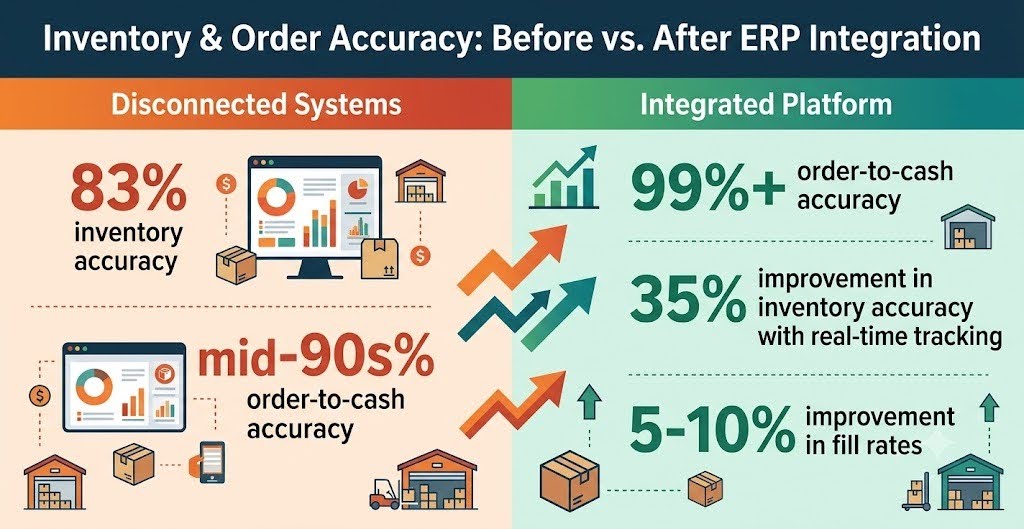
One of the most striking findings in recent supply chain research is just how inaccurate inventory records are at most distribution businesses. On average, organizations operate with only about 83% inventory accuracy, meaning nearly one in five inventory records contains some kind of error [Research and Markets, 2025]. For a distributor moving thousands of SKUs across multiple warehouses, that error rate translates directly into stockouts, unnecessary reorders, and eroded customer trust.
This is precisely the problem that integrated planning platforms are designed to solve. Because a properly implemented Supply Chain ERP centralizes inventory data across every location and sales channel, it eliminates the lag between what’s physically on the shelf and what the system says is on the shelf.
The downstream effects of inventory inaccuracy are often invisible until you go looking for them. A warehouse team might spend hours every week doing “emergency” cycle counts to reconcile discrepancies. Sales reps might quote availability that doesn’t actually exist, leading to awkward calls walking back commitments. Finance teams might carry phantom inventory on the books that was actually written off or damaged months ago. Each of these is a small inefficiency on its own – but multiplied across an entire warehouse operation, they add up to real money and real reputational risk.
4. Real-Time Visibility Can Improve Inventory Accuracy by Over a Third
The improvement isn’t marginal. Estimates suggest that real-time tracking systems – the kind enabled by cloud-based platforms – can improve inventory accuracy by around 35% compared to traditional periodic counting methods [Anchor Group, 2026]. That’s the difference between guessing what’s in your warehouse once a week and knowing exactly what’s there at any given moment.
For B2B distributors, this matters even more than it does for retail. A retail stockout might cost you a single sale. A distribution stockout can mean a broken commitment to a wholesale buyer who placed a bulk order, damaged relationships with key accounts, and lost trust that’s difficult to rebuild – especially when that buyer has other supplier options just a phone call away.
There’s also a compounding effect worth noting: once inventory data is trustworthy, every other process that depends on it gets better automatically. Demand forecasting becomes more accurate because it’s working from real numbers instead of estimates. Purchasing decisions improve because buyers aren’t ordering blind. Customer service teams can give honest, confident answers about availability instead of hedging with “let me check and call you back.” Real-time visibility isn’t just an inventory fix – it’s a foundation that every other operational improvement gets built on top of.
5. Order-to-Cash Accuracy Jumps Dramatically with Integrated Systems
Order accuracy is another area where the data is hard to ignore. Distributors operating on disconnected systems – separate tools for inventory, order entry, invoicing, and shipping – typically see order-to-cash accuracy in the mid-90% range. Integrated platforms, by contrast, push that accuracy above 99%, while also reducing split shipments and improving fill rates by 5 to 10% [Anchor Group ERP Statistics, 2025].
That improvement compounds. Higher fill rates mean fewer partial shipments, which means lower freight costs, fewer customer service escalations, and stronger renewal rates from B2B accounts that depend on predictable, complete deliveries.
It’s also worth considering what “order-to-cash” actually represents from a cash flow perspective. Every step in that process – order placement, picking, packing, shipping, invoicing, and payment collection – is a potential point of friction or delay. When a Supply Chain ERP connects these steps into a single flow, invoices go out faster, errors that delay payment (wrong quantities, wrong pricing, missing documentation) drop significantly, and the entire cash conversion cycle shortens. For distributors operating on tight working capital, that acceleration can be just as valuable as the cost savings themselves.
6. Inventory Optimization Is the Most Common ERP Benefit Reported
When companies are asked what benefits they’ve actually seen after implementing an ERP system, inventory optimization comes out on top by a wide margin. Among organizations that have had at least one phase live for over a year, 91% reported optimized inventory levels as a direct result of their implementation [Jacopo.ee ERP Statistics, 2025].
This is a particularly relevant data point for distribution leaders evaluating new software, because it suggests that inventory-related gains aren’t a “maybe” – they’re close to a guaranteed outcome of a well-executed rollout.
“Optimized inventory” sounds abstract, but it translates into very concrete outcomes: less cash tied up in slow-moving stock, fewer write-offs from expired or obsolete inventory, better space utilization in the warehouse, and fewer emergency orders at premium freight rates to cover shortfalls. For a distributor carrying millions of dollars in inventory at any given time, even a modest reduction in excess stock – freeing up that capital for other uses – can have a meaningful impact on overall financial flexibility.
7. Cost Reductions Are Real, Especially in Purchasing and Inventory Control
Beyond inventory optimization, roughly 62% of businesses report that their ERP system helped reduce costs, with the most pronounced savings showing up in purchasing and inventory control [RubinBrown ERP Advisory, 2025]. For distributors operating on thin margins – which describes most of the wholesale sector – even modest percentage reductions in purchasing costs can have an outsized impact on overall profitability.
This is one of the strongest arguments for treating a Supply Chain ERP investment as a profit driver rather than a cost center. The software pays for itself not by generating new revenue directly, but by eliminating the inefficiencies that quietly drain margin every single day.
Purchasing cost reductions often come from sources that aren’t obvious at first glance. Better demand visibility means fewer rush orders at premium pricing. Consolidated purchasing across locations means more leverage with suppliers for volume discounts. Automated reorder points mean fewer manual errors that result in over-ordering or duplicate purchase orders. None of these are dramatic on their own, but together they represent a meaningful shift in how efficiently a distribution business deploys its purchasing dollars.
8. Productivity Gains Are Consistent Across Company Sizes
Productivity improvements following ERP implementation are one of the most consistently reported benefits in the data. Depending on the source, somewhere between 74% and 78% of companies report increased productivity and operational efficiency after adopting an integrated system [RubinBrown ERP Advisory / Jacopo.ee, 2025]. For distribution businesses, where teams often juggle order processing, inventory updates, customer service, and reporting across multiple disconnected tools, a unified platform removes a huge amount of manual, repetitive work.
Think about the number of times the same piece of information – a customer’s address, a product’s price, an order’s status – gets typed into a different system by a different person throughout a single transaction. Each of those re-entries is an opportunity for error, and each one consumes staff time that could be spent on higher-value work like customer relationships, demand planning, or business development. Productivity gains from ERP consolidation often show up first in the time employees get back, and only later in measurable output metrics.
9. Cloud Supply Chain ERP Delivers Significantly Higher ROI Than On-Premise Systems
The choice between cloud and on-premise deployment isn’t just a technical decision anymore – it’s a financial one. Research from Nucleus Research found that cloud ERP implementations deliver 4.01 times the ROI of on-premises systems, largely driven by faster deployment timelines and lower infrastructure costs [Nucleus Research, via Zconsulto ERP ROI Report, 2026].
For mid-sized distributors that don’t have large in-house IT teams, this is one of the clearest signals in the data: cloud-based Supply Chain ERP isn’t just easier to manage, it’s also the financially smarter choice in most cases.
The infrastructure savings alone are significant – no servers to maintain, no IT staff dedicated to patching and uptime, no costly hardware refresh cycles every few years. But the bigger driver is speed to value. On-premise implementations often take so long that by the time the system is fully live, business needs have already shifted. Cloud platforms, with faster deployment and more frequent updates, let distributors start realizing benefits sooner and adapt the system as their business evolves rather than being locked into a configuration designed years earlier.
10. Most ERP Implementations Meet ROI Expectations – But Only When Planned Properly
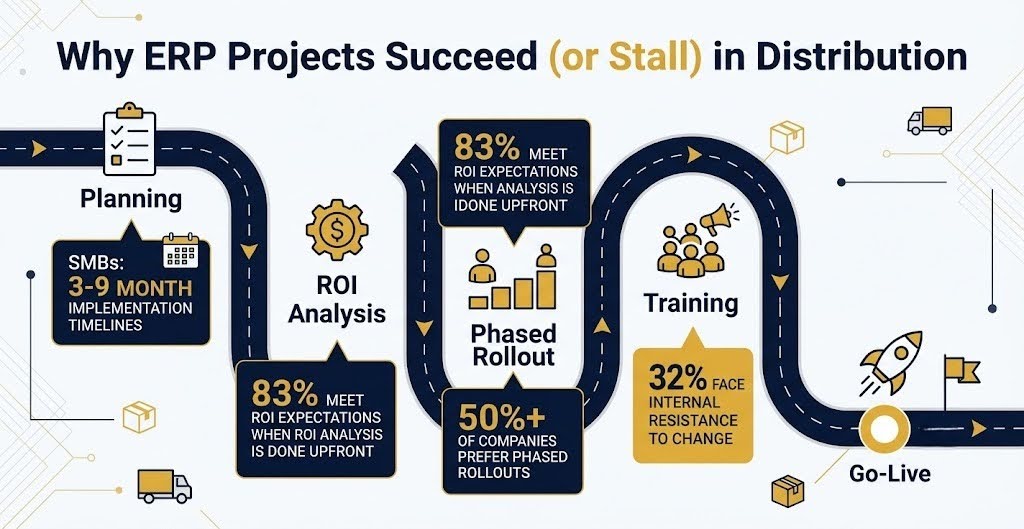
Among organizations that conducted a formal ROI analysis before implementation and have been live for more than a year, 83% reported that their system met or exceeded ROI expectations [Jacopo.ee ERP Statistics, 2025]. The key phrase there is “conducted a formal ROI analysis.” Businesses that go in with clear benchmarks and goals are far more likely to see those goals realized – which underscores the importance of treating a Supply Chain ERP selection as a strategic project, not just a software purchase.
This is a point that often gets lost in the sales process. Vendors are happy to talk about features and capabilities, but the businesses that see the strongest results are typically the ones that started by asking internal questions first: What does success actually look like for us? What metrics will we track before and after? Who owns this project internally, and what does their success look like? Without that groundwork, even a technically excellent implementation can feel like it “didn’t deliver” simply because nobody defined what delivering would look like.
11. Implementation Timelines Vary Widely Based on Business Size
One of the most practical data points for distribution leaders relates to timelines. Small to midsize businesses typically implement ERP systems within 3 to 9 months, while large enterprises may take up to 18 months [RubinBrown ERP Advisory, 2025]. Additionally, over half of companies now prefer a phased implementation strategy over an all-at-once “big bang” rollout [RubinBrown ERP Advisory, 2025].
For distributors, this matters because it sets realistic expectations. A platform rollout isn’t a weekend project – but it also doesn’t have to be a multi-year disruption if it’s scoped and phased correctly.
A phased approach also has a practical advantage that’s easy to overlook: it gives the organization early wins. Rather than waiting a year for a single “go-live” date where everything changes at once, a phased rollout might bring inventory management online first, then order processing, then financials, then ecommerce integration. Each phase delivers value on its own and gives the team a chance to build confidence and competence with the new system before the next module goes live – reducing the shock of change and the risk of a failed launch.
12. Nearly a Third of Wholesalers Face Internal Resistance to Change
Technology alone doesn’t guarantee success. Roughly 32% of wholesalers report experiencing resistance to change from employees and/or management during ERP rollouts [BlueLink ERP Statistics, 2025]. This is consistently cited as one of the leading causes of delayed or underperforming implementations.
The implication for leadership is clear: a Supply Chain ERP rollout is as much a change management initiative as it is a technology initiative. Training, communication, and internal buy-in are not “extras” – they’re core to whether the investment pays off.
Resistance to change rarely comes from malice – it usually comes from fear. Warehouse staff worry the new system will make their jobs harder before it makes them easier. Sales teams worry about disruptions to customer relationships during the transition. Finance teams worry about data integrity during migration. Addressing these concerns directly, involving frontline staff in testing and feedback before go-live, and being transparent about the timeline and what to expect can dramatically reduce friction – and friction is almost always the difference between an implementation that goes smoothly and one that becomes a cautionary tale.
13. B2B eCommerce Is Now a Multi-Trillion-Dollar Channel – and ERP Is the Backbone
For distributors, B2B ecommerce isn’t a side channel anymore – it’s central to growth. The North American B2B ecommerce market reached approximately $5.17 trillion in 2025, with 65% of B2B companies now transacting fully online and ecommerce accounting for 18% of their revenue [BlueLink ERP Statistics, 2025]. Globally, B2B ecommerce is estimated at roughly $32 trillion [RepSpark Wholesale Industry Trends, 2025].
None of this growth is sustainable without a Supply Chain ERP feeding accurate, real-time data into ecommerce platforms. Pricing, inventory availability, order status, and shipping information all need to flow seamlessly between the ERP and the storefront – otherwise, B2B buyers experience the same frustrations as retail consumers: wrong prices, out-of-stock surprises, and order delays.
What’s especially important here is that B2B ecommerce buyers often place larger, more complex orders than retail consumers – multi-line orders, custom pricing tiers, contract-based terms, and recurring purchase schedules. A storefront that isn’t connected to a real Supply Chain ERP can’t reliably support that complexity. It might show a price that doesn’t reflect a customer’s negotiated contract terms, or display stock as available when it’s already been allocated to another order. These aren’t minor glitches in a B2B context – they’re the kinds of errors that cause large accounts to walk away.
14. B2B Buyers Now Behave Like Consumers – and Expect Mobile-First Experiences
The expectations of B2B buyers have shifted significantly. Approximately 80% of B2B buyers now use mobile devices for research and transactions [BlueLink ERP Statistics, 2025]. This means distributors can no longer treat their digital storefront – or the systems behind it – as an afterthought. A mobile-responsive ordering experience, backed by a system that can sync inventory and pricing in real time, is quickly becoming table stakes rather than a differentiator.
This shift reflects a broader generational change in B2B purchasing. The buyers placing orders today grew up with consumer apps that show real-time delivery tracking, instant order confirmations, and personalized recommendations. They bring those same expectations to their professional purchasing decisions – and a distributor whose digital experience feels like it’s stuck in 2010 sends an unintentional signal about how modern (or outdated) the rest of the operation might be.
15. The Future Is AI-Driven, Industry-Specific, and Resilience-Focused
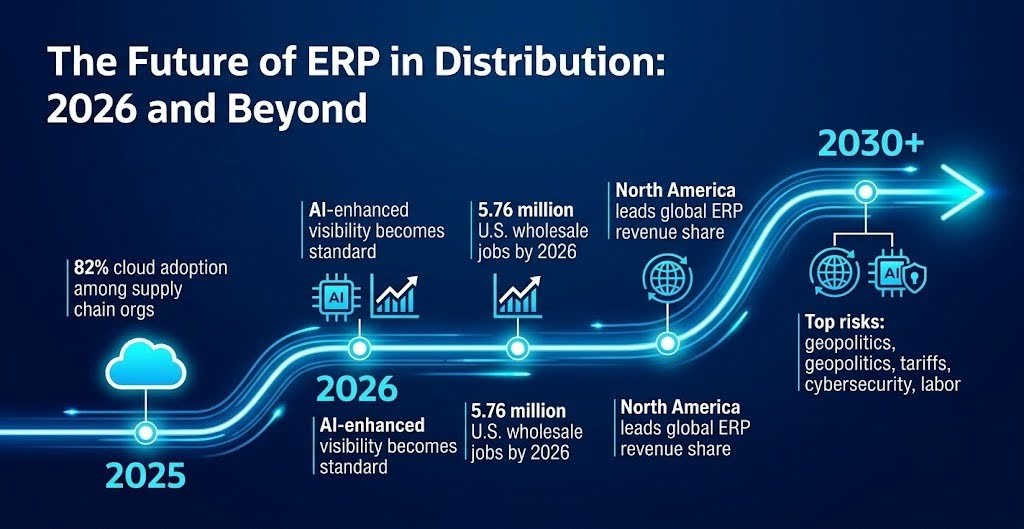
Looking ahead, the trends shaping enterprise platforms in 2026 and beyond point in a consistent direction: less generic software, more specialized capability. Industry analysis indicates that ERP trends for 2026 prioritize AI-enhanced supply chain visibility and industry-specific modules over one-size-fits-all platforms [BlueLink ERP Statistics, 2025]. At the same time, cloud computing and storage adoption among supply chain organizations is approaching 82% [RepSpark Wholesale Industry Trends, 2025].
Risk management is also climbing the priority list. Recent supply chain risk surveys point to geopolitics, tariffs, labor shortages, ESG requirements, and cybersecurity as the dominant threats organizations are planning around [BlueLink ERP Statistics, 2025]. A modern Supply Chain ERP increasingly needs to do more than manage inventory – it needs to help businesses model risk, diversify suppliers, and respond quickly when disruptions hit.
Finally, the broader employment picture reinforces just how central this sector remains to the U.S. economy. The U.S. wholesale industry is projected to employ approximately 5.76 million people by 2026 [BlueLink ERP Statistics, 2025], and North America is expected to continue holding the largest share of global ERP revenue, supported by high cloud adoption and advanced technology infrastructure [BlueLink ERP Statistics, 2025].
The AI angle deserves particular attention because it’s moving faster than most other trends. Early applications in distribution include demand forecasting that adjusts automatically based on seasonality and market signals, automated reorder suggestions that factor in supplier lead times and price fluctuations, and anomaly detection that flags unusual order patterns before they become fulfillment problems. These aren’t far-off concepts – they’re features actively being rolled into platforms today, and the gap between businesses using them and businesses that aren’t is likely to widen quickly over the next few years.
What This Means for Your Business
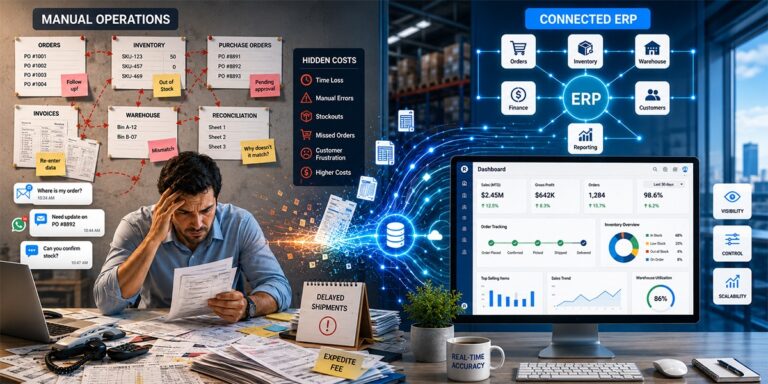
Taken individually, each of these data points tells a small story. Taken together, they tell a much bigger one: the operational gap between distributors running on modern, integrated systems and those still relying on disconnected tools is no longer a matter of convenience – it’s a matter of competitiveness. Inventory accuracy, order fulfillment speed, purchasing efficiency, and digital buyer experience are no longer separate problems to be solved one at a time. They’re all symptoms of the same underlying issue: whether your business has a single, reliable source of truth for its operations.
The good news is that the path forward doesn’t require a leap of faith. The data on outcomes – inventory optimization, cost reduction, productivity gains, and ROI – is remarkably consistent across multiple independent sources. The businesses that struggle are rarely the ones that chose the “wrong” software in a vacuum; they’re the ones that underestimated the planning, change management, and phased execution that successful implementations require.
Bringing It All Together
The data paints a consistent picture: a modern Supply Chain ERP is no longer a back-office utility for wholesalers and distributors – it’s a frontline competitive tool. From the 92% adoption rate among distributors, to the 35% inventory accuracy gains from real-time visibility, to the 4x ROI advantage of cloud deployments, the numbers all point in the same direction. Businesses that invest in the right platform, plan their implementation carefully, and manage the change process internally are seeing measurable, repeatable returns.
For distribution leaders evaluating their next move, the question is no longer whether a Supply Chain ERP investment is worth it. The data already answers that. The real question is how quickly your business can move from legacy systems and disconnected tools to a platform that gives you the visibility, accuracy, and resilience the next phase of growth demands – and how deliberately you plan that transition to make sure the results match the investment.
- What is ERP in supply chain?
ERP (Enterprise Resource Planning) in supply chain is a software system that integrates inventory management, procurement, warehousing, logistics, and order processing into a single platform. It helps businesses gain real-time visibility, improve coordination, and streamline supply chain operations.
- Which ERP is best for SCM?
The best ERP for Supply Chain Management (SCM) depends on business size and requirements. Popular options include SAP SAP S/4HANA for large enterprises, Oracle Oracle Fusion Cloud ERP for advanced supply chain operations, and Microsoft Microsoft Dynamics 365 for businesses seeking flexibility and integration. For most organizations, SAP is often considered the industry leader due to its comprehensive SCM capabilities.
- Which is better, SAP SCM or SAP MM?
SAP SCM and SAP MM serve different purposes, so one is not necessarily better than the other. SAP SCM focuses on end-to-end supply chain planning, forecasting, logistics, and demand management, while SAP MM (Materials Management) specializes in procurement, purchasing, inventory, and supplier management.
For complete supply chain optimization, SAP SCM is more comprehensive, whereas SAP MM is ideal for managing purchasing and inventory processes within an ERP system.
- What is ERP, HCM, and SCM?
ERP (Enterprise Resource Planning) manages core business processes such as finance, inventory, procurement, and operations in a unified system. HCM (Human Capital Management) handles employee-related functions like recruitment, payroll, training, and performance management, while SCM (Supply Chain Management) focuses on sourcing, production, inventory, logistics, and product delivery.
- What are the 4 pillars of ERP?
The four core pillars of ERP are Finance, Human Resources, Supply Chain Management, and Customer Relationship Management. Together, these modules help organizations streamline operations, improve decision-making, and enhance overall business performance.
- What are the 4 types of CRM?
The four main types of CRM are Operational CRM, Analytical CRM, Collaborative CRM, and Strategic CRM. Operational CRM automates sales and customer service, Analytical CRM analyzes customer data, Collaborative CRM improves communication across teams, and Strategic CRM focuses on building long-term customer relationships.

 Get Started