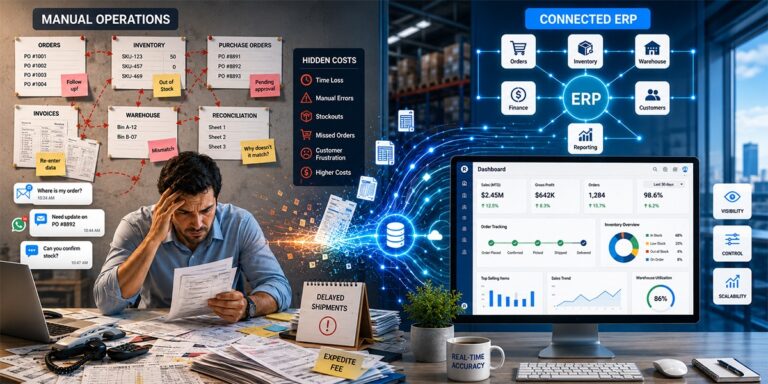
Efficiency, speed, and accuracy are key factors in today’s manufacturing organizations. Delays, expensive mistakes, and poor decision-making are frequently the results of manually managing production schedules, inventories, supply chains, and client orders or using disjointed systems.
ERP Manufacturing becomes a potent answer in this situation. Businesses can increase efficiency, streamline procedures, and have real-time visibility throughout the whole organization by combining all corporate operations into a single, centralized system.
We’ll look at how ERP Manufacturing functions, why it’s important for contemporary manufacturers, and how it may change everything from production scheduling to final delivery in this tutorial.
What is ERP Manufacturing?
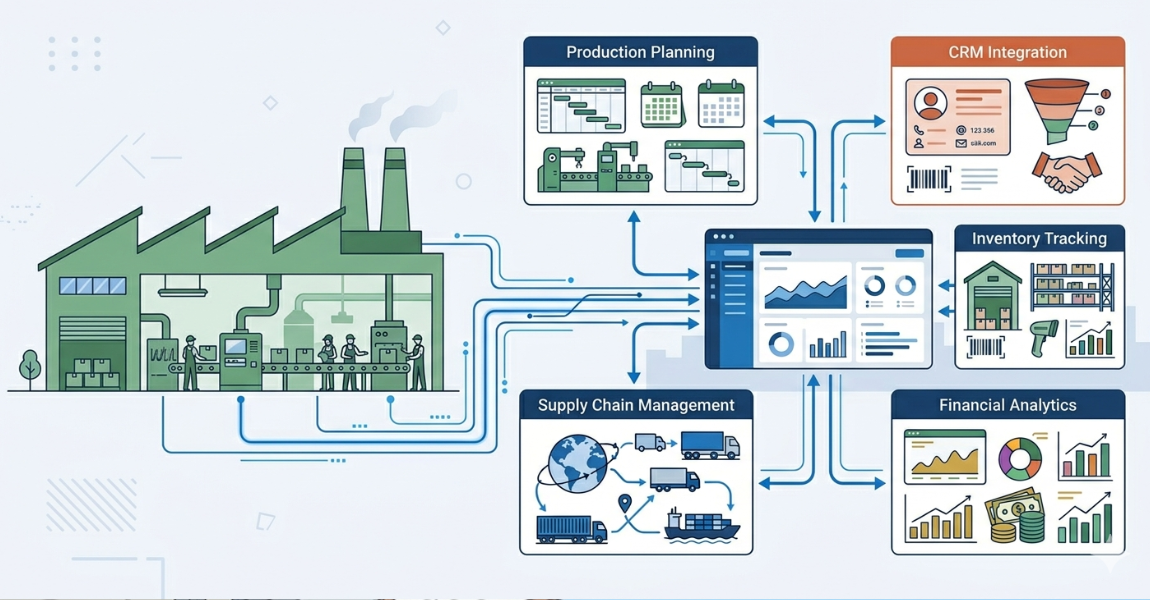
ERP Manufacturing is the term used to describe the application of enterprise resource planning systems created expressly to oversee and improve manufacturing processes. Production planning, purchasing, inventory, sales, financing, and distribution are all connected on one platform.
ERP Manufacturing allows companies to manage their whole production ecosystem from a single, cohesive system rather than depending on numerous disparate technologies. By ensuring that data moves seamlessly between departments, this integration enables executives to make choices more quickly and intelligently.
ERP Manufacturing reduces human labor and operational inefficiencies while giving manufacturers more access into inventory levels, manufacturing status, and supply chain performance.
Why Manufacturing Businesses Need ERP
Complex workflows and departmental collaboration are necessary for manufacturing operations. Even minor errors can cause significant disruptions in the absence of a centralized system.
Typical difficulties faced by producers include:
- Errors in manual data entering
- Delays in production
- Inability to see inventories in real time
- Miscommunication in the supply chain
- Ineffective order processing
- Inadequate demand projections
By establishing a networked environment where all departments share the same data and procedures, ERP Manufacturing implementation aids in the resolution of these issues.
ERP Manufacturing gives firms control, precision, and efficiency throughout the production, inventory, sales, and distribution processes.
Key Features of ERP Manufacturing Systems
Multiple modules created especially for production-driven organizations make up a robust ERP Manufacturing solution.
1. Production Planning and Scheduling
One of the most important components of successful manufacturing is production planning.
ERP Manufacturing enables companies to:
- Make manufacturing schedules that are automated.
- Monitor work orders in real time
- Allocate resources as efficiently as possible
- Cut down on production delays
- Boost the use of machines
The system makes ensuring that labor, equipment, and supplies are in line with production objectives.
2. Inventory and Warehouse Management
Managing inventories is frequently one of the most difficult tasks in production.
Businesses benefit from a sophisticated ERP Manufacturing platform:
- Keep track of both raw supplies and final products.
- Real-time stock level monitoring
- Minimize stockouts or overstocking
- Boost the effectiveness of the warehouse
- Automate procedures for reordering
ERP Manufacturing gives businesses total visibility into inventory flow between production floors and warehouses.
3. Supply Chain Management
Suppliers and logistical partners are crucial to manufacturers.
ERP Manufacturing enhances productivity and collaboration by integrating procurement teams, production planners, and suppliers into a single system.
Advantages consist of:
- Improved connection with suppliers
- Precise demand projections
- Better planning for procurement
- Quicker order fulfillment
- Decreased interruptions in the supply chain
Production won’t ever halt because of missing ingredients thanks to this connectivity.
4. Quality Control Management
Maintaining product quality is essential for customer satisfaction and regulatory compliance.
Companies can:
- Monitor quality assurance throughout the production process.
- Track the rates of defects
- Keep records of compliance
- Boost the uniformity of the product
- Determine production problems fast.
Businesses can ensure greater standards and lower expensive product recalls by including quality management into ERP Manufacturing.
Financial and Cost Management
For manufacturers to stay profitable, operating costs must be continuously monitored.
ERP Manufacturing directly connects production and inventory activities with financial data.
This enables businesses to:
- Monitor manufacturing expenses in real time
- Effectively manage budgets
- Observe profit margins.
- Examine the causes of costs.
- Boost your financial forecasting
Decision-makers can see precisely where funds are being spent and where enhancements are required thanks to ERP Manufacturing.
How ERP Manufacturing Improves Operational Efficiency
By eliminating operational bottlenecks and automating repetitive operations, ERP Manufacturing greatly increases productivity.
The following are some of the most significant increases in productivity that companies encounter:
Manufacturing operations are slowed down by manual processes. Inventory updates, order processing, and production tracking are examples of repetitious operations that ERP Manufacturing automates.
Decision-makers can respond swiftly to operational changes because they have fast access to corporate data.
A consolidated ERP Manufacturing platform allows departments like manufacturing, sales, finance, and logistics to collaborate easily.
Reduced Operational Errors
The risk of human data entry errors, which frequently cost manufacturers thousands of dollars, is decreased by automation and real-time synchronization.
ERP Manufacturing for Distribution Businesses
Manufacturers and distribution partners frequently collaborate closely. Maintaining smooth operations depends on effectively managing this relationship.
Businesses can optimize distribution processes using ERP Manufacturing by:
- Order management automation
- Taking care of client-specific pricing
- Real-time shipping tracking
- Making warehouse operations more efficient
- Increasing the visibility of inventories
Specialized workflows that adjust to shifting company requirements are supported by contemporary ERP Manufacturing solutions made for distribution companies.
Integrating ERP Manufacturing with B2B Ecommerce
Customers today demand quick and easy ordering processes. To satisfy these demands, a large number of manufacturing and distribution businesses are implementing B2B e-commerce platforms.
There are various benefits of integrating ERP Manufacturing with e-commerce platforms.
- Real-time price adjustments
- Product catalogs tailored to individual customers
- Management of bulk orders
- Synchronization of inventory
- Order processing that is automated
Businesses can sell products online even after regular business hours while keeping precise inventory and pricing when e-commerce systems are connected to ERP Manufacturing.
ERP Manufacturing and Smart Forecasting
In manufacturing, precise demand forecasting is essential. While generating too little inventory results in lost sales, producing too much inventory raises expenses.
ERP Manufacturing assists companies with demand forecasting by examining:
- Sales data from the past
- Trends by season
- Consumer buying habits
- Performance of the supply chain
Businesses may plan production more efficiently and cut waste by using predictive insights.
Benefits of ERP Manufacturing for Modern Businesses
Businesses that use ERP Manufacturing frequently see notable gains in a variety of operational domains.
Among the main advantages are:
Employees may concentrate on higher-value tasks instead of manual data entry thanks to automation and process improvement.
Business executives can obtain precise insights for strategic planning through real-time analytics and reporting.
Improved Customer Satisfaction
Stronger customer relationships result from quicker order processing, precise deliveries, and reliable product quality.
ERP Manufacturing solutions can accommodate rising production volumes and operational complexity as businesses expand.
Centralized systems provide the appropriate management of sensitive data and enhance data security.
How to Successfully Implement ERP Manufacturing
Planning and execution must be done carefully for an ERP Manufacturing deployment to be effective.
Here are a few crucial actions:
1. Evaluate Business Needs
Determine which ERP features will be most beneficial and identify operational issues.
2. Choose the Right ERP Partner
Long-term success and a more seamless installation are guaranteed when you choose an experienced ERP provider.
3. Prepare Data and Processes
Businesses should standardize workflows and clean up current data prior to deployment.
4. Train Employees
Employee proficiency with the system is ensured by user training.
5. Monitor and Optimize
Following implementation, businesses should keep an eye on system performance and streamline procedures.
The Future of ERP Manufacturing
Manufacturing technology is still developing quickly. The upcoming generation of ERP Manufacturing systems is getting smarter and more connected.
Among the new trends are:
- Production scheduling powered by AI
- Integration of IoT with devices and sensors
- Predictive upkeep
- Advanced reporting and analytics
- ERP systems that are cloud-based
Companies who use ERP Manufacturing to implement these advances will have a competitive edge in terms of operational control, scalability, and efficiency.
Conclusion: Transform Your Manufacturing Operations with ERP
Today’s manufacturing companies need to run more quickly, intelligently, and effectively than in the past. Without a centralized system, manufacturing, inventory, distribution, and customer demand management can result in expensive mistakes and lost opportunities.
Organizations may automate workflows, unify operations, and have total company insight by implementing ERP Manufacturing. ERP Manufacturing builds a strong basis for long-term success through everything from inventory control and production scheduling to e-commerce connectivity and financial monitoring.
It’s time to implement a cutting-edge ERP system if your company is prepared to do away with human errors, increase operational effectiveness, and confidently scale manufacturing operations.
Workflow optimization and system upgrades are already being implemented by your rivals.
Don’t hold off.
Make an appointment for a consultation with our professionals right now to learn how our cutting-edge ERP solutions can revolutionize your manufacturing processes and accelerate your company’s growth.








 Get Started