Introduction: Why Businesses Need Strategic ERP Guidance
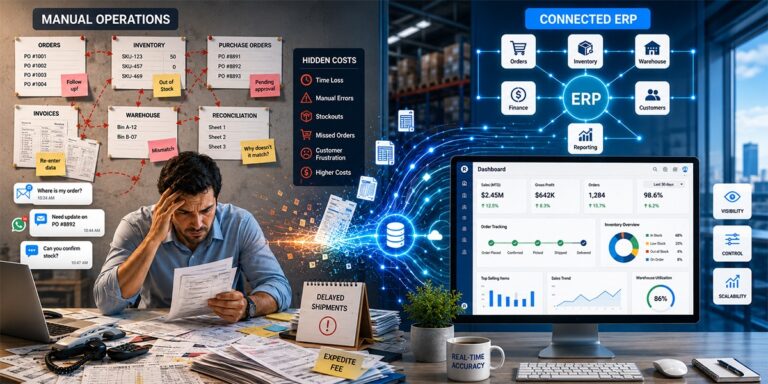
Complex operations involving supply chains, digital sales channels, inventory, finance, and customer management are managed by modern businesses. Businesses encounter operational inefficiencies, data discrepancies, and delays when these systems function independently.
ERP Consulting becomes crucial in situations like these. Companies require strategic assistance to develop systems that are in line with their operational goals, as opposed to merely deploying enterprise software.
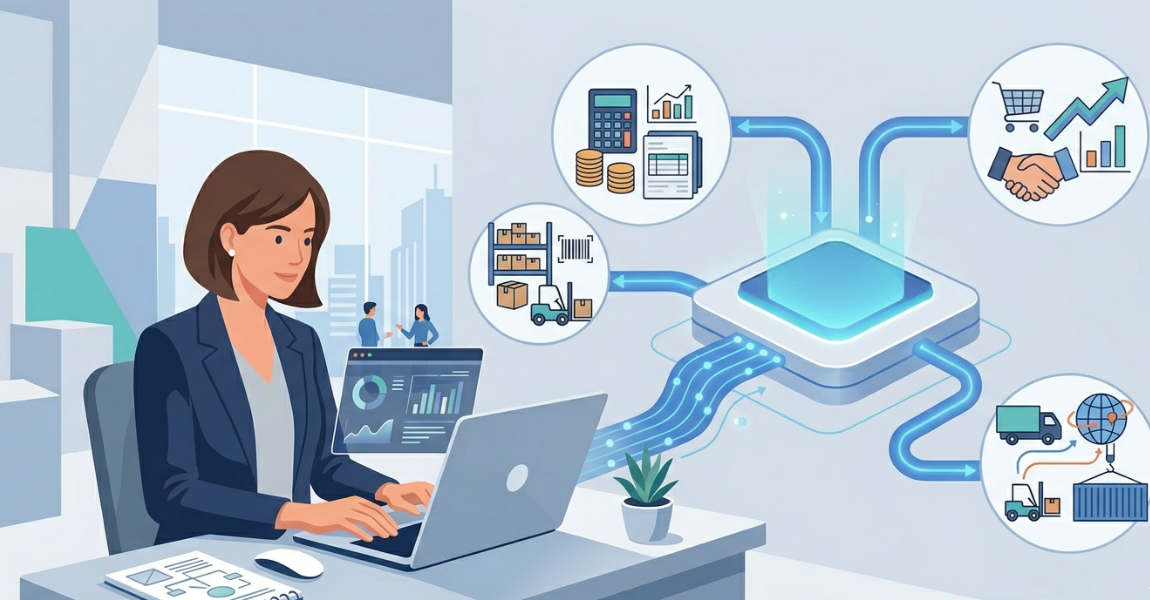
Businesses can assess current procedures, spot inefficiencies, and put in place an ERP system that unites all departments into a single, efficient platform with the help of expert ERP Consulting.
Effective ERP Consulting frequently results in quicker decision-making, better operational management, and scalable growth possibilities for organizations.
It is now essential to have the proper ERP strategy in the cutthroat digital world of today. Long-term corporate success depends on it.
Understanding ERP Consulting
ERP Consulting is the term used to describe expert services that assist companies in developing, implementing, customizing, and optimizing enterprise resource planning systems.
ERP experts examine business procedures and provide solutions that combine several departments, including customer relations, procurement, inventory control, and finance, into one system.
The following are often included in a thorough ERP Consulting process:
- Analysis of business processes
- Planning and system selection
- Configuring and implementing ERP
- Integration of systems
- Instruction and continuing assistance
ERP Consulting guarantees that ERP systems provide optimal value and efficiency by assisting firms through these phases.
Why Businesses Invest in ERP Consulting
Without professional assistance, ERP system implementation frequently results in expensive errors, delays, and operational disruptions.
To prevent these risks and guarantee a successful deployment, businesses rely on ERP Consulting.
ERP Consulting is used by businesses for the following main reasons:
- Decreasing inefficiencies in operations
- Removing mistakes from manual data entering
- Enhancing departmental data visibility
- Facilitating business process automation
- Ensuring a seamless ERP deployment
Organizations can change their operations without interfering with regular business operations by using competent ERP Consulting.
ERP Consulting for Distribution Businesses
Complex workflows involving suppliers, warehouses, inventory, and client orders are managed by distribution organizations. Significant financial damage can result from even one manual entry error.
Distribution companies can implement systems created especially for their operational requirements with the aid of specialized ERP Consulting.
Important ERP functions that are advantageous to distributors include:
- Flexible business processes
- Advanced inventory control
- Automated order fulfillment
- Pricing that is unique to each consumer
- Reporting on state taxes and compliance
Distributors can get systems that lower operational risks and boost productivity with industry-focused ERP Consulting.
Businesses can go live in a matter of weeks thanks to the rapid implementation of many contemporary ERP solutions.
Integrating ERP Consulting with B2B Ecommerce
Convenient digital purchase choices are preferred by modern consumers. Companies that only use manual ordering procedures run the risk of losing clients to rivals that offer online ordering.
Because of this, many businesses incorporate e-commerce platforms into their ERP Consulting initiatives.
ERP-connected B2B e-commerce platforms provide significant advantages like:
- Online ordering is available around-the-clock
- Pricing relevant to customers and locations
- Capability for bulk ordering
- Smooth interaction with internal systems
- Intelligent demand forecasting
Businesses can develop e-commerce platforms that generate sales even after regular business hours with strategic ERP Consulting.
Marketing Advantages After ERP Consulting
ERP systems offer useful corporate data that supports marketing efforts when they are applied correctly.
Businesses can better understand consumer behavior and product demand by using the insights gathered via ERP Consulting.
ERP data can be used by marketing teams to:
- Send notifications when products are replenished or new
- Start specialized advertising campaigns
- Expand into new geographical markets
- Advertise goods prior to trade exhibits
Businesses can interact with clients via integrated marketing systems by:
- Campaigns via email
- SMS alerts
- Platforms for messaging
- Promotions at trade shows
These tactics boost revenue prospects and generate demand.
Ecommerce Maintenance and ERP Consulting
Starting an online store is just the first step. For long-term success, platform optimization and maintenance are equally crucial.
Systems that allow continuing e-commerce maintenance are frequently set up during ERP Consulting.
Important maintenance skills consist of:
- Pricing updated in real time
- Same-day updates to product listings
- Quick technical assistance
- Dependable and safe website infrastructure
- Ongoing search engine optimization
By implementing these methods, businesses can guarantee that their online stores continue to be profitable and competitive.
POS Integration Through ERP Consulting
Integrating point-of-sale systems with ERP platforms is very beneficial for retail and distribution companies.
Professional ERP Consulting assists companies in integrating POS systems with backend operations to establish unified commerce environments.
Advantages consist of:
- Quicker checkout processes
- Automated synchronization of inventories
- Real-time sales data
- Management of loyalty and incentives programs
- Automated tax computations
Businesses obtain total insight across both online and physical sales channels when POS systems are integrated into ERP platforms.
Quick Commerce and ERP Consulting
Convenience and speed are increasingly important aspects of contemporary business. Consumers anticipate quick purchase alternatives and immediate product availability.
Businesses can adopt quick commerce solutions that allow for speedy online shop launch through superior ERP Consulting services.
Capabilities for quick trade include:
- Opening e-commerce sites in a single day
- Synchronization of inventory in real time
- Options for delivery and pickup
- Ordering systems that are mobile-friendly
- POS systems’ direct integration
These characteristics enable companies to sustain effective operations and react swiftly to market demand.
Challenges Businesses Face Without ERP Consulting
Businesses that try to deploy ERP without professional assistance frequently encounter significant difficulties.
Typical problems consist of:
- Inadequate setup of the system
- Mistakes in data migration
- Failures in integration
- Issues with employee adoption
- Project delays and higher expenses
By offering organized implementation techniques and technical know-how, Professional ERP Consulting lowers these risks.
Best Practices for Successful ERP Consulting
Businesses should adhere to tried-and-true best practices when implementing ERP systems to optimize their advantages.
- Define Clear Business Objectives
Organizations must decide what they hope to accomplish with ERP Consulting before starting the ERP project, such as automation, cost savings, or better reporting.
- Prepare Data Before Implementation
For ERP adoption to be successful, data accuracy is essential. ERP Consulting ensures a seamless conversion by cleaning and organizing current corporate data.
- Train Employees for System Adoption
ERP systems have an effect on several departments. Following ERP Consulting, training programs make sure that staff members are proficient in using the new system.
- Choose an Experienced ERP Partner
One of the most crucial choices made during ERP deployment is choosing the appropriate technology partner. Long-term support and seamless system deployment are guaranteed by knowledgeable specialists.
The Future of ERP Consulting
Enterprise technology is still developing quickly. These days, ERP systems are becoming more intelligent, adaptable, and networked.
ERP Consulting is being impacted by the following new developments:
- Analytics driven by artificial intelligence
- Forecasting demand with prediction
- Sophisticated automation of the supply chain
- Integrated platforms for retail and e-commerce
Early adoption of these advances gives businesses a competitive edge and increases operational effectiveness.
Building a Long-Term ERP Strategy
Instead of viewing ERP systems as one-time technological investments, successful companies view them as long-term strategic assets.
ERP Consulting supports the following sustainable ERP strategies:
- Ongoing optimization of the system
- Frequent advancements in technology
- Incorporation of digital platforms
- Continuous training for employees
These procedures guarantee that ERP systems develop in tandem with the expansion of businesses.
Conclusion: Transform Your Operations with ERP Consulting
Integrated systems that link processes, boost productivity, and foster digital expansion are essential for modern enterprises. ERP adoption can get complicated and expensive without the proper plan.
Designing, implementing, and optimizing enterprise systems that enable long-term corporate performance is the responsibility of Professional ERP Consulting.
ERP solutions are essential to contemporary business operations, from providing marketing automation and speedy commerce capabilities to streamlining distribution processes and integrating e-commerce platforms.
The capacity to automate procedures, lower operational errors, and scale effectively as their company expands is a benefit that ERP Consulting provides to organizations.
Now is the time to move forward if your business is prepared to increase productivity, optimize processes, and create a cutting-edge technological base for future expansion.
Get in touch with our team right now to see how our digital integration services, e-commerce solutions, and ERP knowledge can revolutionize your company. Make an appointment for a consultation to learn how the appropriate ERP approach might open up new business prospects.









 Get Started