Introduction: Why ERP Applications Are Transforming Modern Businesses
Businesses are expected to function quickly, accurately, and efficiently in today’s fast-paced digital market. Using disjointed systems to manage several departments, including finance, inventory, sales, and customer support, frequently results in inefficiencies and expensive mistakes.
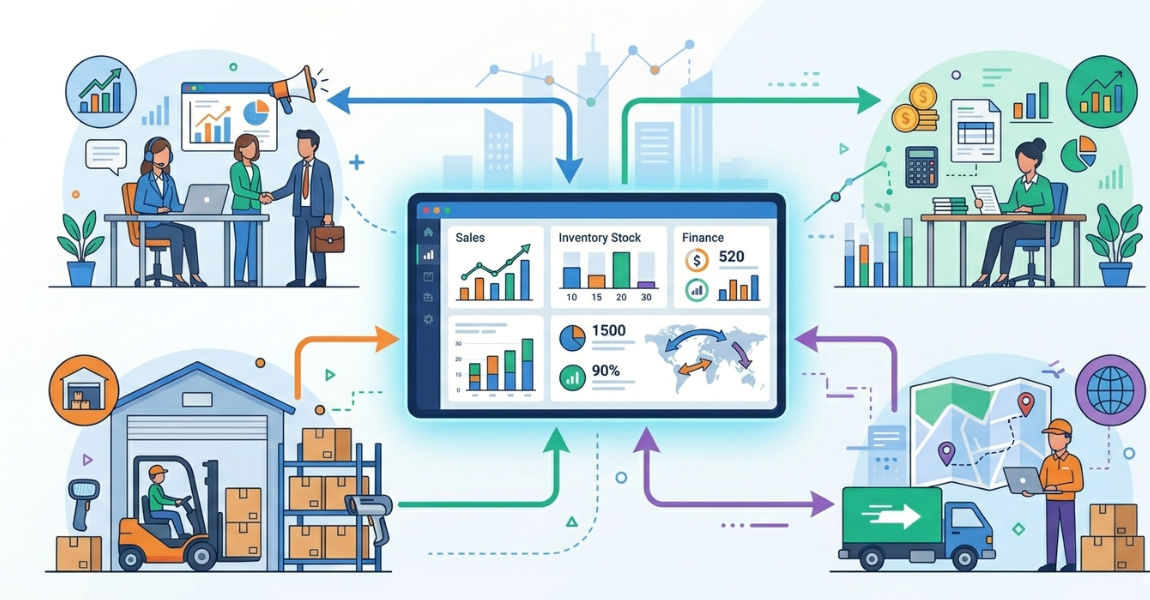
An ERP Application is crucial in situations like these. It serves as a centralized system that links all business operations, allowing businesses to run smoothly. Businesses that use the appropriate ERP Application increase decision-making, gain greater control over processes, and decrease manual errors.
Operations become more difficult as companies expand. In addition to streamlining procedures, a well-implemented ERP Application offers a solid platform for long-term expansion and scalability.
Understanding ERP Application
- What is an ERP Application?
A software program called an ERP Application is made to combine and oversee essential business operations on a single platform. It enables businesses to automate departmental procedures and centralize data.
An ERP Application performs the following tasks:
- Management of finances
- Tracking of inventory
- Coordination of the supply chain
- Management of client data
- Sales and order fulfillment
Businesses can reduce data silos and increase operational efficiency with a robust ERP Application by implementing a unified system.
Why Businesses Need an ERP Application
When employing several unrelated tools, organizations frequently encounter difficulties. Data duplication, communication breakdowns, and delayed decision-making are some of these difficulties.
These problems are solved by a contemporary ERP Application:
- Granting access to data in real time
- Enhancing departmental cooperation
- Decreasing the amount of manual labor
- Assuring the accuracy of the data
A more effective and productive workplace is created by businesses who invest in a strong ERP Application.
Core Features of an ERP Application
Numerous elements that simplify business operations are provided by a good ERP Application.
- Centralized Data Management
Centralized data storage is one of the main benefits of an ERP Application. The same data is accessible to all departments, guaranteeing accuracy and consistency.
Any ERP Application must include automation as a crucial component. It minimizes human mistake and eliminates repetitive processes.
Examples consist of:
- Automated invoicing and billing
- Workflows for order processing
- Updates to the inventory
Real-time business performance insights are provided by a contemporary ERP Application.
Companies can keep an eye on:
- Trends in sales
- Levels of inventory
- Financial results
- Consumer behavior
These insights assist firms in making prompt, well-informed decisions.
ERP Application for Distribution Businesses
Distribution businesses handle a variety of intricate tasks, such as customer-specific pricing, transportation, and inventory control.
Distribution-specific capabilities are available from a specialized ERP Application:
- Automated order processing
- Adaptable business processes
- Pricing models tailored to individual customers
- Adherence to tax laws
Significant distribution losses might result from even a minor human error. Such hazards are removed and operational accuracy is increased by implementing an ERP Application.
Faster digital transformation is ensured by the speed at which many contemporary technology enable firms to go online.
ERP Application and B2B Ecommerce Integration
The way organizations engage with their customers has been altered by digital transformation. Consumers now demand quick, easy, and adaptable shopping experiences.
When a B2B e-commerce platform and an ERP Application are combined:
- Online ordering around-the-clock
- Options for bulk purchases
- Pricing that is unique to each consumer
- Smooth interaction with backend systems
These features guarantee that companies can continue to sell goods after regular business hours.
Companies build a digital environment around their ERP Application that improves the customer experience and boosts sales.
ERP Application in Marketing and Demand Generation
Sending catalogs and conducting simple campaigns are no longer the only aspects of marketing. To target the correct audience, businesses need data-driven strategies.
By offering insightful client data, an ERP Application improves marketing activities.
Teams in charge of marketing can:
- Advertise products that are back in stock and fresh
- Conduct focused campaigns
- Interact with clients via a variety of mediums
- Enter new markets
Businesses can develop customized marketing plans that boost demand and boost revenue by utilizing data from an ERP Application.
ERP Application for Ecommerce Website Maintenance
A successful e-commerce platform needs ongoing upkeep and improvements. Maintaining online stores’ effectiveness and modernity requires an ERP Application.
Among the key advantages of upkeep are:
- Pricing updated in real time
- Instantaneous adjustments to product listings
- Rapid problem solving
- Improved security of websites
Consistent performance and a better customer experience are guaranteed by regular optimization backed by an ERP Application.
ERP Application and POS Integration
Integrating point-of-sale systems with ERP platforms is quite beneficial for retail organizations.
POS systems and an ERP Application offer:
- Quicker checkout procedures
- Synchronization of inventory in real time
- Comprehensive sales reports
- Automated tax computations
By seamlessly integrating online and offline activities, these features increase productivity and client satisfaction.
ERP Application for Quick Commerce
Consumers today demand convenience and speed. Companies need to promptly adjust to these demands.
A well-designed ERP Application facilitates rapid commerce by enabling:
- Quick establishment of an online store
- Updates on prices in real time
- Options for delivery and pickup
- Synchronization of inventory
These characteristics assist companies in seizing opportunities in rapidly evolving marketplaces.
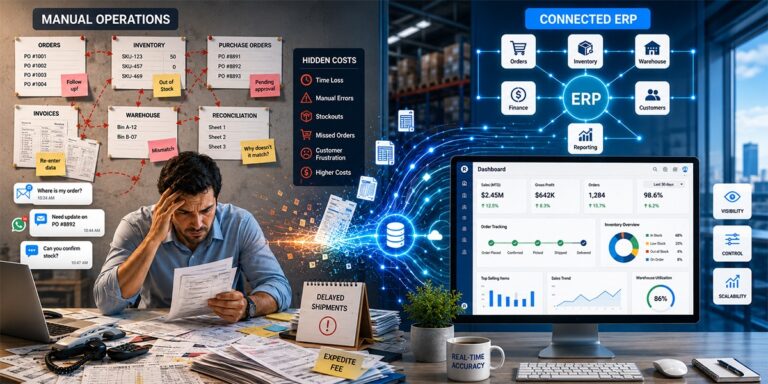
Challenges Without an ERP Application
Without an ERP Application, businesses frequently struggle with operational inefficiency.
Typical difficulties consist of:
- Mistakes in manual data entry
- Absence of current insights
- Ineffective inventory control
- Sluggish decision-making procedures
These problems may restrict expansion and lessen market competition.
By putting into place an ERP Application, these difficulties can be overcome, and a more productive workplace is produced.
Best Practices for ERP Application Implementation
Businesses should adhere to planned installation procedures to get the most out of an ERP Application.
Organizations must determine their objectives and anticipated results prior to implementation.
For business success, choosing the appropriate ERP Application is essential.
System performance and a seamless migration are guaranteed by accurate and clean data.
The ERP Application may be used more efficiently by teams with the right training.
Businesses may sustain the long-term advantages of an ERP system with regular evaluation and optimization.
Future Trends in ERP Application
ERP systems now have new possibilities because of ongoing technological advancements.
The ERP Application will undergo the following developments:
- Analytics powered by AI
- Forecasting demand with prediction
- Automation of intricate processes
- Increased e-commerce platform integration
Adopting these developments will provide businesses a competitive edge in the online market.
Building a Growth Strategy with ERP Application
A solid technological base is necessary for a business plan to be effective. The resources required to expand operations and increase productivity are provided by an ERP Application.
A growth-oriented strategy consists of:
- ERP integration with e-commerce systems
- Utilizing data to inform marketing tactics
- Optimizing workflows continuously
- Enhancing the client experience
Successful organizations can achieve long-term success and sustained growth by utilizing their ERP Application properly.
Conclusion: Transform Your Business with ERP Application
Businesses need to embrace technology that boosts productivity and fosters expansion in the current competitive landscape. A modern business’ success depends on having an ERP Application, which is no longer a choice.
An ERP Application is essential to boosting corporate efficiency, from optimizing distribution procedures to enabling sophisticated e-commerce capabilities and enhancing marketing tactics.
Businesses that make the proper ERP solution investments increase customer happiness, cut expenses, and have more control over their operations.
Now is the time to take action if your company is prepared to automate processes, remove human error, and create a scalable digital infrastructure.
Get in touch with our team right now to find out how our marketing know-how, e-commerce development services, and ERP systems may help you revolutionize your company’s operations. Take the first step in creating a more intelligent and effective business system by setting up a meeting or making a phone call.








 Get Started