







For wholesalers and distributors, a single mis fulfilled order doesn’t just cost the price of a return it costs customer trust, operational time, and margin you cannot afford to lose. Manual order entry, disconnected systems, and spreadsheet-driven workflows have long been the silent killers of distribution efficiency. Today the data tells a clear story: businesses that adopt ERP automation are cutting order errors by up to 80%, recovering hundreds of labor hours per month, and scaling without adding operational chaos.
This guide pulls from verified industry research to show exactly how wholesalers and B2B distributors are using modern technology to transform their order operations and what the numbers look like on the other side.
The Real Cost of Manual Order Processing in Distribution
Before understanding what fixes the problem, you need to see what the problem actually costs. Distribution is a precision business. A wrong SKU, a missed pricing rule, a duplicated purchase order each creates a cascade: a warehouse team repacking, a customer service rep apologizing, an accounts receivable team chasing a credit memo.
Most order errors in distribution do not begin in the warehouse. They begin upstream in disconnected commercial and operational processes in the gap between what sales promised, what the system recorded, and what the warehouse actually received.
The scale of exposure is significant. 62% of respondents in warehouse operations surveys identified human error from manual process management as the number one root cause of inventory fulfillment issues. That is not a warehouse problem in isolation. It is a systems problem and the fix is structural.
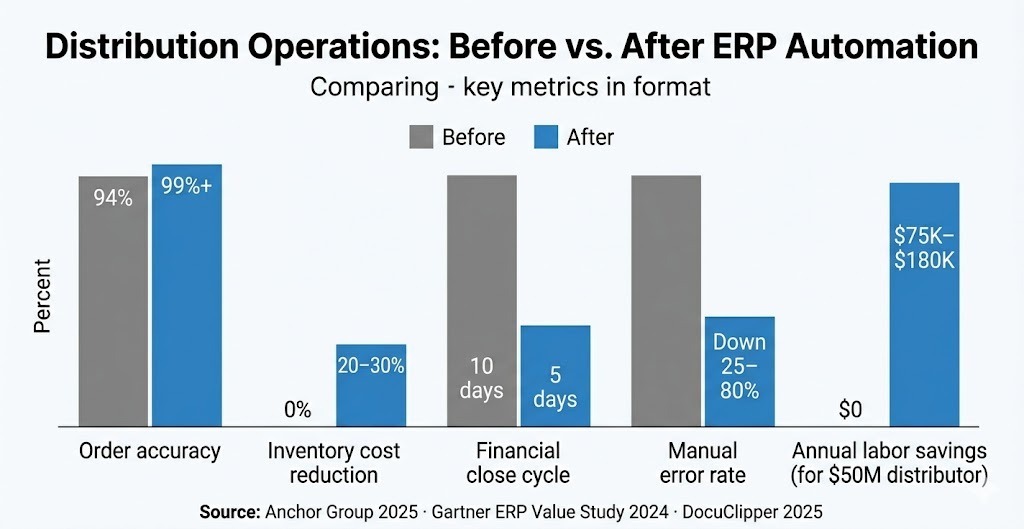
The financial impact compounds quickly. For distributors with $50 million in revenue, operational improvements from a properly implemented integrated platform translate to $75,000–$180,000 in annual labor savings alone. [Anchor Group] These are documented outcomes from real distribution operations, not vendor projections.

What Changes When You Automate Order Operations
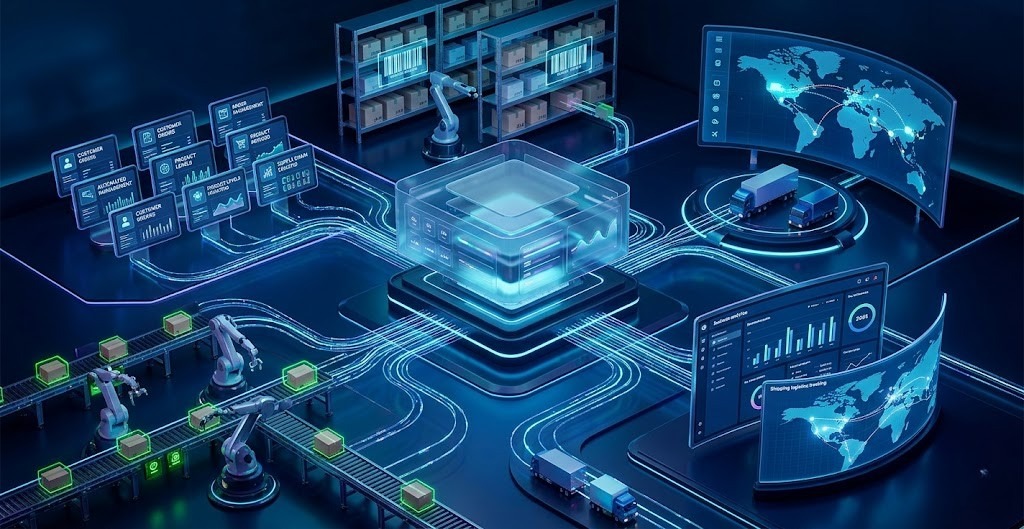
Modern distribution platforms designed around ERP automation connect order capture, pricing validation, inventory allocation, fulfillment, shipping, invoicing, and exception handling inside a single governed workflow. The result is a system where rules enforce themselves removing the human gaps where errors breed.
- Automated order validation catches pricing discrepancies, stock availability issues, and customer credit exceptions before the order reaches the warehouse floor. Instead of a picker discovering a problem, the system surfaces it at the point of entry.
- Real-time inventory sync means sales reps quote accurately. When inventory data isn’t updated in real time, reps can promise 500 units that don’t actually exist and warehouse teams may receive the wrong item because duplicate or outdated SKUs cause confusion during receiving.
- Automated pricing enforcement protects margins. Wholesale customers expect contract pricing, volume discounts, and rebate programs. In fragmented systems, these rules live in spreadsheets or someone’s memory, leading to errors that quietly eat into margins. Distribution-focused platforms automate pricing by customer, product, and quantity protecting profitability without manual checks at every transaction.
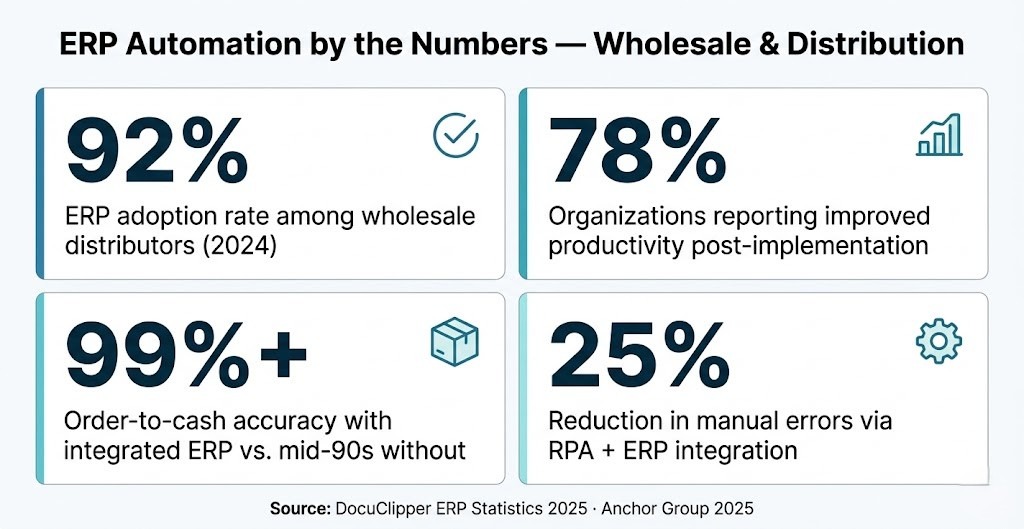
The cumulative impact of these controls is well-documented. Organizations using integrated platforms achieve 99%+ order-to-cash accuracy, compared to mid-90s performance from disconnected systems. [Anchor Group] That gap a few percentage points translates to hundreds of costly exceptions, credits, and returns eliminated every month at any meaningful order volume.
The Statistics: What Businesses Are Actually Achieving
The headline of this guide references up to 80% order error reduction. Here is where that figure comes from, and what surrounds it in the data.
The integration of Robotic Process Automation with ERP automation platforms has led to a 30% increase in efficiency for rule-based tasks and a 25% reduction in manual errors. [DocuClipper] These gains compound across every touchpoint in the order lifecycle from entry to fulfillment to invoicing.
Companies implementing AI-enabled ERP automation have reported a 20% improvement in forecasting accuracy and a 15% reduction in operational costs. [DocuClipper] For distributors managing hundreds of SKUs across multiple suppliers, improved forecasting directly reduces both stockouts and overstock situations two of the most expensive inventory problems in wholesale.

78% of organizations reported improved productivity after implementation, and 62% reported reduced costs, particularly in purchasing and inventory control. [DocuClipper] Inventory accuracy in advanced automated operations reaches 99.99% in some documented cases a benchmark simply unachievable with manual counting and disconnected systems. [Seller’s Commerce]
Adoption has reached near-universality in the industry. 92% of wholesale distribution firms used ERP software in 2024, making it one of the highest-adoption industries. Distributors represent 18% of all ERP buyers, ranking second only to manufacturing. [Anchor Group]
Where Errors Occur Across the Order Lifecycle
Mapping error reduction requires understanding where errors actually originate. In B2B distribution, the order lifecycle touches at least six distinct operational areas: order capture, pricing, inventory, fulfillment, shipping, and invoicing. A manual or disconnected environment introduces risk at every handoff between them.
Order capture is where free-text entry creates transposition errors. A quantity of 100 vs. 1,000, or SKU 4782 vs. 4728 one keystroke causes downstream disruption that takes hours to untangle. Structured ordering with automated validation eliminates this category entirely.
Pricing at order time is where contract terms get misapplied. For a wholesale operation with dozens of customer-specific pricing tiers, maintaining accuracy manually is practically impossible at volume. ERP automation enforces the right price for the right customer at the right quantity every time, without human review.
Inventory allocation is where overselling happens. When multiple orders compete for the same stock and counts are stale, fulfillment failures are inevitable. Real-time reservation within an automated system prevents this from happening in the first place.
Invoicing is the final step where revenue is captured and where manual re-entry creates discrepancies between what shipped and what was billed. Automated invoice generation from confirmed shipment data removes this category of error entirely.
Modern distribution platforms with these capabilities deliver 20–30% reductions in inventory costs through automated demand planning and replenishment. [Anchor Group] For a mid-size distributor carrying significant inventory value, that is a material working capital improvement. Financial close cycles also reduce by 50% through automation, cutting typical 10-day closes to 5 days freeing finance teams for strategic work rather than manual reconciliation. [Anchor Group]
The ROI Case for Distributors
The business case for ERP automation does not rest on qualitative benefits alone. The return on investment data for distribution-focused implementations is strong and well-documented.
Distributors typically achieve ROI near 90% over five years, with payback within 2–3 years. [Anchor Group] That is a compelling investment profile particularly when the alternative of maintaining fragmented systems carries its own compounding cost in errors, returns, and customer attrition.
Among organizations that performed ROI analysis before going live, 83% reported meeting their ROI expectations. [DocuClipper] This demonstrates that well-scoped projects deliver predictable, not speculative, returns.
Gartner’s 2024 ERP Value Study supports these outcomes, noting that organizations modernizing to composable, cloud-based ERP environments realize up to 30% faster time-to-value and 20% higher process efficiency compared with those maintaining legacy core systems. [Rand Group]
The labor savings for mid-market distributors are particularly concrete. A $50 million distributor typically realizes $75,000–$180,000 per year in labor-efficiency gains savings that compound across order entry, inventory management, purchasing, warehouse operations, and financial close processes. [Anchor Group] The recovered capacity enables redeployment toward higher-value activities like customer relationship management and strategic vendor negotiations.
ERP Automation and B2B Ecommerce: Why the Integration Matters
For wholesale distributors operating in B2B ecommerce environments, the technology takes on an additional dimension. B2B buyers increasingly expect the same seamless experience they have as consumers real-time product availability, accurate pricing at login, instant order confirmation, live shipment tracking. Delivering that manually at scale is not realistic.
When a B2B ecommerce platform is tightly connected to the distribution ERP automation layer, every customer-facing interaction is powered by accurate, real-time back-end data. The customer’s portal shows their contract pricing automatically. Their credit limit is checked at checkout. When they reorder, the system validates inventory, reserves stock, and generates the pick list without any human handoff.
This eliminates the painful lag that plagues distributors running ecommerce on top of disconnected back-end systems: manual order re-entry from the web portal into the ERP, “we’ll confirm by email” delays, and pricing discrepancies discovered only when a customer disputes an invoice weeks later.
ERP platforms with embedded intelligence features have enabled companies to achieve a 35% improvement in decision-making speed and a 20% improvement in overall business agility. [DocuClipper] In a B2B distribution context, that agility means faster response to demand spikes, more accurate lead times communicated to customers, and quicker resolution of supply disruptions.
By 2025, 65% of ERP vendors were expected to integrate AI and machine learning capabilities into their platforms to enhance forecasting, analytics, and approval processes. [DocuClipper] This will widen the performance gap between distributors running modern integrated ERP automation and those still on legacy or fragmented systems.
Implementation Pitfalls: Why Some Operations Don’t See the Gains
The statistics above are achievable but they require deliberate execution. It would be incomplete to present ERP automation data without acknowledging that implementation outcomes vary significantly based on how the project is run.
The most common failure mode for distributors is treating implementation as a software installation project rather than an operational transformation. The system itself is only as good as the process discipline around it. If order entry rules aren’t enforced, pricing tables aren’t maintained, and inventory counts aren’t reconciled regularly, the platform becomes sophisticated record-keeping rather than an error-prevention engine.
Top causes of budget overruns include underestimating project staffing requirements (38%), expanding initial scope beyond what was defined (35%), and unanticipated technical or data issues (34%). [DocuClipper] All three are avoidable with proper scoping and realistic timelines.
Change management is consistently underestimated. 45% of distribution employees actively use ERP systems daily, which requires intentional training programs not a one-time onboarding session. Organizations should budget for ongoing training as the system evolves and as staff changes. [Anchor Group] The distributors achieving the highest error reduction rates are those who treat adoption as an ongoing investment, not a launch-day checkbox.
Selecting the Right Platform for Distribution
Not every ERP solution is built with distribution workflows in mind. Generic platforms designed for manufacturing or retail often require heavy customization to handle wholesale-specific requirements and that customization is where cost and complexity escalate beyond initial projections.
Distribution-specific platforms are built around the workflows that matter most to wholesalers: high-volume order processing, complex multi-tier pricing, multi-warehouse inventory, EDI with major retail partners, and integrated B2B ecommerce. These platforms deliver ERP automation that works out of the box for distribution use cases.
The key capabilities to evaluate include automated order validation with rules-based exception handling, real-time multi-location inventory management, automated pricing enforcement for contract and volume tiers, native EDI connectivity, B2B ecommerce integration with real-time data sync, and automated invoicing tied directly to shipment confirmation.
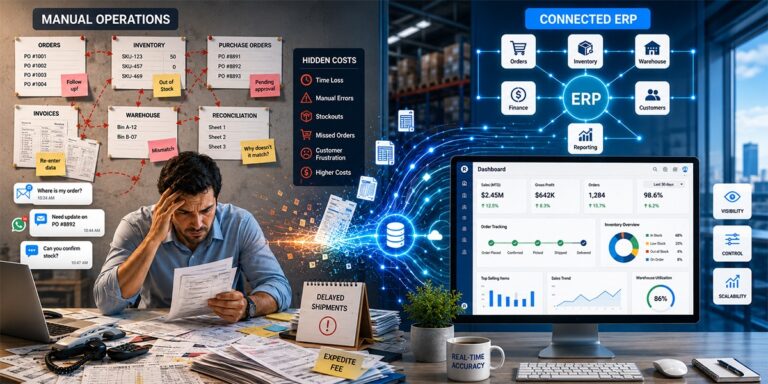
When these capabilities are present and properly implemented, the path to 80% order error reduction becomes a matter of execution not aspiration. Integrating different functions across your organization into a single unified system gives every department visibility into the same data simultaneously, eliminating the version conflicts and communication gaps that create errors in fragmented environments. [Cavallo]

Conclusion: The Competitive Window Is Narrowing
The data makes one thing clear: ERP automation is no longer a differentiator for wholesale distributors it is the operational baseline. With 92% of wholesale distribution firms already using it, the question is no longer whether to adopt it, but how well to implement it. [Anchor Group] The distributors achieving 80% error reduction, 99%+ order accuracy, and six-figure annual labor savings are not doing so by accident. They have invested in distribution-focused ERP automation, integrated it deeply with their B2B ecommerce operations, and committed to the process discipline that makes the technology deliver on its promise.
For wholesalers still running on fragmented systems, disconnected spreadsheets, or legacy platforms not built for modern distribution complexity every order error is a data point, every manual workaround is a cost, and every competitor already on an automated platform is widening the gap.
The statistics in this guide are documented outcomes from real distribution operations. The question is whether yours will be among them.
FAQs
- What is ERP automation?
ERP automation is the use of software to automatically handle repetitive business processes like order entry, invoicing, inventory updates, and pricing across your entire distribution operation in one connected system. It eliminates manual data entry and human handoffs by linking every department to a single source of real-time data.
- What are the 4 pillars of ERP?
The 4 pillars of ERP are Finance (managing accounting, invoicing, and cash flow), Operations (handling order processing, inventory, and fulfillment), Human Resources (tracking staff, payroll, and performance), and Supply Chain (managing procurement, vendors, and logistics). Together, these four pillars connect every core business function into one unified, automated system.
- What are the 4 types of automation?
The 4 types of automation are Fixed Automation (repetitive, high-volume tasks with no variation), Programmable Automation (batch processes that can be reconfigured for different outputs), Flexible Automation (adaptable systems that handle multiple tasks simultaneously), and Intelligent Automation (AI-powered processes that learn, decide, and self-optimize over time). In distribution and ERP contexts, most modern platforms combine programmable and intelligent automation to handle order processing, pricing, and fulfillment workflows.
- What are L1, L2, L3, and L4 processes?
L1 (Level 1) are top-level business processes like “Order Management” or “Procurement,” L2 breaks those into major functions like “Order Entry” or “Purchase Order Creation,” L3 defines the specific workflow steps within each function like “Validate Customer Pricing” or “Approve Purchase Order,” and L4 is the most granular level covering individual task instructions like “System checks contract price against customer account before confirming order.” In ERP automation, L3 and L4 are where automation delivers the most direct error reduction and efficiency gains for distributors.
- What are the 4 stages of automation?
The 4 stages of automation are Assisted Automation (humans do the work but tools assist with data entry and alerts), Partial Automation (systems handle specific tasks while humans manage exceptions), Conditional Automation (the system runs most processes independently and only escalates edge cases to humans), and Full Automation (end-to-end processes run completely without human intervention, from order capture to invoice generation). Most wholesalers and distributors today operate between stages 2 and 3, with modern ERP automation pushing operations toward stage 4.
- What are the 7 stages of testing?
The 7 stages of testing are Requirements Analysis (understanding what needs to be tested), Test Planning (defining scope, tools, and timelines), Test Case Design (writing specific scenarios to validate each function), Test Environment Setup (configuring systems to mirror real operating conditions), Test Execution (running the test cases and recording results), Defect Reporting (logging and prioritizing issues found), and Test Closure (reviewing outcomes, signing off, and documenting lessons learned). In ERP automation implementations for distributors, these stages are critical before go-live to ensure order processing, pricing rules, and inventory sync all perform accurately under real conditions
 Get Started