Introduction: Why ERP Platforms Are the Backbone of Modern Enterprises
Businesses are expected to function quickly, accurately, and efficiently in the cutthroat commercial world of today. Managing several departments using different systems frequently results in missed opportunities, data problems, and delays.
An ERP Platform can be a game-changing solution in situations like these. Organizations may streamline operations, increase accuracy, and grow effectively by integrating all business activities into a single system with an ERP Platform.
Businesses who make the proper ERP Platform investment benefit from real-time visibility, minimize manual labor, and provide a solid basis for expansion. Adopting a cutting-edge ERP Platform is now necessary because of the ongoing digital transformation.
Understanding ERP Platform
Finance, inventory, sales, procurement, and customer management are just a few of the key company operations that may be integrated into an ERP Platform.
An ERP Platform should have the following capabilities:
- Centralized administration of data
- Automation of workflow
- Reporting in real time
- Smooth departmental integration
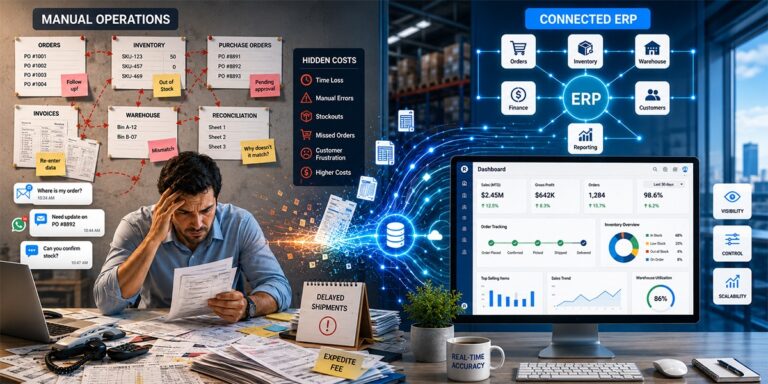
Businesses can reduce data silos and boost operational efficiency by utilizing a single ERP Platform.
Why Businesses Need an ERP Platform
Inefficiencies and a lack of coordination are common problems for organizations that depend on disjointed systems. These issues are successfully handled by a modern ERP Platform.
The following are the main justifications for using an ERP Platform:
- Reduce errors in manual data entering
- Enhance teamwork among teams
- Facilitate quicker decision-making
- Guarantee the accuracy and consistency of the data
Businesses that use an ERP Platform are better able to manage demanding markets and intricate processes.
Core Features of an ERP Platform
A contemporary ERP Platform offers a number of features that support corporate growth and operational effectiveness.
Unified data access across all departments, which guarantees correctness and consistency, is a key benefit of an ERP Platform.
- Automation of Business Processes
Within an ERP Platform, automation lowers monotonous processes and boosts productivity.
Examples consist of:
- Automatic billing
- Processing orders
- Updates to the inventory
Making decisions quickly and intelligently is made possible by an ERP Platform, which offers real-time insights into corporate performance.
ERP Platform for Distribution Businesses
Distribution firms handle a lot of transactions and intricate supplier systems. Significant costs can result from even a tiny mistake.
Distribution-specific capabilities are available from a specialized ERP Platform:
- Distribution-specific automated workflows
- Features of customer-specific pricing
- Precise management of taxes and compliance
- Quick system implementation
Distributors can reduce errors and boost operational effectiveness with the appropriate ERP Platform.
ERP Platform and B2B Ecommerce Integration
Consumers today demand flawless online shopping experiences. Businesses can satisfy these demands by integrating e-commerce features into an ERP Platform.
Among the main advantages are:
- Online ordering around-the-clock
- Capabilities for large purchases
- Updates on prices in real time
- Integration with current systems
Businesses can make money even outside of regular business hours thanks to an ERP Platform.
Enhancing Marketing with ERP Platform
When marketing plans are supported by reliable data, they become more effective. Businesses can develop focused campaigns with the assistance of an ERP Platform, which offers insightful data.
Businesses can, with an ERP Platform:
- Advertise fresh and replenished goods
- Reach new clientele
- Run messaging, SMS, and email campaigns
- Increase the prominence of the product
These features guarantee that marketing initiatives have quantifiable outcomes.
ERP Platform for Ecommerce Website Maintenance
An e-commerce website needs to be continuously updated and monitored. The procedure is streamlined by an ERP Platform.
Important aspects of maintenance consist of:
- Updates on products in real time
- Precise pricing control
- Rapid problem solving
- Improved security of websites
Businesses relying on an ERP Platform may guarantee reliable performance and satisfied customers.
ERP Platform and POS Integration
Integrating point-of-sale systems with an ERP Platform is beneficial for retail organizations.
This integration makes it possible for:
- Quicker checkout procedures
- Tracking inventory in real time
- Comprehensive sales data
- Automated tax computations
Between online and offline activities, an ERP Platform ensures smooth collaboration.
ERP Platform for Quick Commerce
Consumer demands for convenience and speed are still rising. To remain competitive, businesses need to change swiftly.
Quick commerce is supported by an ERP Platform by:
- Quick establishment of an online store
- Synchronization of inventory in real time
- Adaptable delivery choices
- Mobile-friendly encounters
These characteristics enable companies to effectively respond to market demands.
Challenges Without an ERP Platform
Without an ERP Platform, businesses frequently experience operational difficulties.
Typical problems consist of:
- Mistakes in manual data
- Absence of current insights
- Ineffective processes
- Restricted scalability
Overcoming these obstacles and enhancing overall performance is made possible by implementing an ERP Platform.
Best Practices for Implementing an ERP Platform
Businesses should adhere to planned installation procedures to get the most out of an ERP Platform.
Prior to installing an ERP Platform, clearly define your goals.
- Choose the Right Solution
Based on business requirements, choosing the right ERP Platform is essential.
For a seamless system migration, make sure the data is accurate and tidy.
Effective use of the ERP Platform is ensured by appropriate training.
Maintaining long-term effectiveness requires regular monitoring and upgrades.
Future Trends in ERP Platform
The future of ERP systems is being shaped by technological developments.
ERP Platform is now experiencing the following trends:
- Analytics powered by AI
- Forecasting with prediction
- Automation of intricate processes
- Greater integration of e-commerce
Adopting these advances will provide businesses a competitive advantage.
Building a Growth Strategy with ERP Platform
Effective processes and data-driven insights are necessary for a successful business plan. To accomplish this, an ERP Platform offers the necessary capabilities.
A growth-oriented strategy consists of:
- ERP integration with e-commerce platform
- Making marketing decisions based on data
- Continuously improving workflows
- Enhancing the client experience
Organizations can achieve sustainable growth if they successfully utilize their ERP Platform.
Conclusion: Transform Your Business with ERP Platform
Businesses need to implement technologies that boost productivity and foster expansion in the current digital environment. To manage operations, increase accuracy, and boost performance, an ERP Platform offers a comprehensive solution.
An ERP Platform is essential to business success since it can streamline distribution procedures, enable sophisticated e-commerce features, and enhance marketing efforts.
Businesses that make the proper ERP solution investments increase customer happiness, cut expenses, and have more control over their operations.
Now is the ideal time to take action if your company is prepared to remove human error, automate processes, and create a scalable digital infrastructure.
Get in touch with our team right now to see how our ERP solutions, e-commerce development services, and marketing knowledge will assist you in putting in place a strong ERP Platform. Take the next step in creating a more intelligent and effective business system by setting up a meeting or consultation.








 Get Started