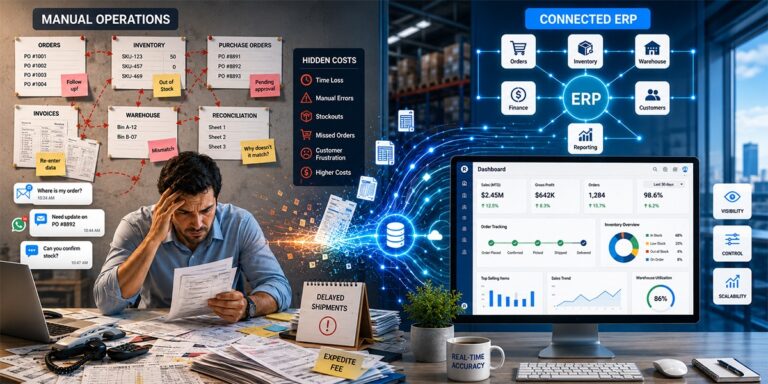
Efficiency, customer relationships, and data-driven decisions determine success in the fiercely competitive business world of today. Disconnected systems, in which sales, operations, customer service, and inventory management function independently, are a problem for many businesses. Errors, misunderstandings, and missed opportunities result from this fragmentation.
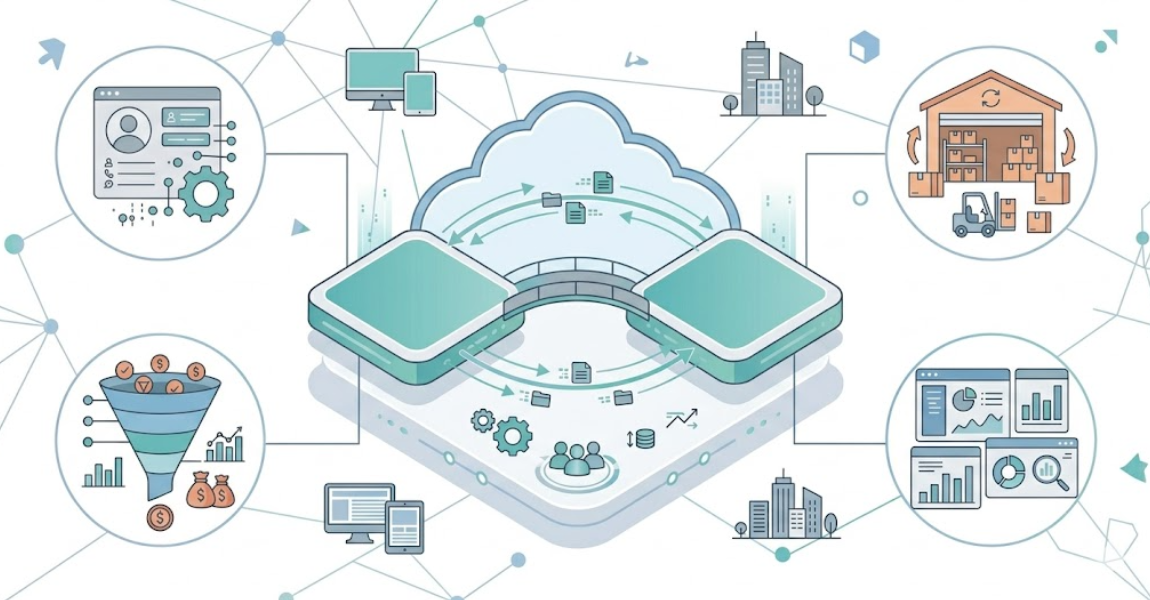
ERP CRM solutions become crucial in this situation. Businesses can manage operations and customer interactions inside a single ecosystem by combining customer relationship management with enterprise resource planning. Better company insights, increased efficiency, and stronger customer relationships are the outcomes.
Organisations may track clients, manage orders, keep an eye on inventory, evaluate sales success, and automate workflows from a single, centralised platform with a well-implemented ERP CRM system. Businesses may run more effectively and provide better client experiences by avoiding the need to switch between different tools.
Adopting an integrated ERP CRM approach is now essential for businesses looking to expand, scale, and successfully compete in today’s digital-first market.
Understanding ERP CRM
What is ERP CRM?
The integration of customer relationship management (CRM) with enterprise resource planning (ERP) systems is known as ERP CRM. While CRM concentrates on managing customer connections, sales funnels, and marketing initiatives, ERP concentrates on managing internal corporate processes including finance, inventories, procurement, and operations.
Businesses receive a comprehensive picture of their operations and clients when these systems collaborate. Management can keep an eye on departmental performance, finance teams can check client orders, and sales teams can access inventory data.
An ERP CRM system’s primary features include:
Management of customer data
Monitoring the sales pipeline
Management of orders and inventory
Operational and financial reporting
Monitoring marketing campaigns
Management of customer service
ERP CRM enables businesses to make more informed decisions and provide superior customer service by integrating operational operations with customer insights.
Why Businesses Need ERP CRM Integration
Eliminating Data Silos
Disconnected data between departments is one of the largest problems that businesses encounter. Teams in sales, operations, and accounting may use different platforms.
ERP CRM ensures that all departments have access to the same correct data by operating within a single system.
Advantages consist of:
Increased precision of data
Quicker decision-making
decreased amount of manual data entering
Improved teamwork
Improved Customer Experience
Consumers anticipate frictionless shopping experiences, quick responses, and individualised interactions.
Businesses can do the following with an integrated ERP CRM system:
Monitor interactions with customers
Keep track of past purchases
Effectively handle orders
Offer assistance more quickly
Long-term loyalty is increased and client relationships are strengthened as a result.
Key Features of ERP CRM Systems
Centralized Customer Data
All client data is kept in one location using an integrated ERP CRM platform. Contact information, purchasing history, support tickets, and communication records can all be readily tracked by businesses.
Advantages consist of:
Customised advertising
Improved sales tactics
Quicker customer support
Sales and Order Management
ERP CRM connection is very beneficial to sales teams. From a single system, they can track orders, produce bids, manage leads, and convert opportunities.
Important skills include of:
Take the lead in management
Monitoring opportunities
Automated quote production
Order fulfilment
Analytics for sales performance
This increases productivity and guarantees that no chances are missed.
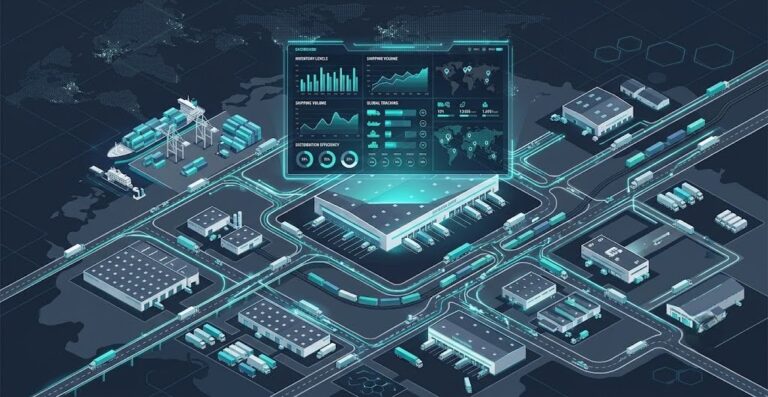
Inventory and Supply Chain Visibility
Sales teams can give customers correct information when they are aware of current inventory levels.
ERP CRM allows companies to:
Real-time inventory tracking
Track the performance of the supply chain
Estimate the demand for the product
Avoid stock shortages
Both internal processes and customer pleasure are enhanced by this transparency.
ERP CRM for Distributors
Distribution companies frequently oversee intricate processes including suppliers, warehouses, logistics, and client orders.
For distributors, a specialised ERP CRM solution can automate crucial procedures like:
Pricing tailored to the customer
Reporting of state taxes
Monitoring inventory
Management of orders
Coordination of suppliers
Thousands of dollars can be lost due to a single manual entry error. Distributors can reduce errors and boost productivity by automating procedures using ERP CRM.
Additionally, a lot of contemporary distribution-focused ERP systems offer:
Workflows that are flexible in business
quick system deployment
committed assistance
characteristics unique to a given industry
Integrating ERP CRM with B2B Ecommerce
Digital ordering is preferred by today’s consumers over phone calls or emails. Companies need to provide smooth online shopping experiences.
Businesses may sell online while maintaining operational data synchronisation thanks to an integrated ERP CRM platform with B2B ecommerce features.
Important e-commerce features consist of:
Pricing tailored to the customer
Features for bulk ordering
Product availability in real time
Order processing that is automated
Connectivity to internal systems
Businesses may sell goods around-the-clock while keeping operational control when e-commerce platforms are directly connected to ERP CRM.
Marketing Automation Through ERP CRM
Marketing is crucial to the expansion of businesses, but without the necessary tools, campaigns can fall short of reaching the intended audience.
Marketing teams can use ERP CRM to:
Monitor consumer behaviour
audiences in segments
automate advertising
evaluate the effectiveness of marketing
Features that work well for marketing include:
Campaigns via email
SMS alerts
announcements of product launches
assistance with trade exhibition marketing
campaigns for customer re-engagement
Businesses can develop focused marketing plans that drive actual demand by utilising consumer insights kept in ERP CRM.
Ecommerce Website Maintenance and ERP CRM
Starting an online store is just the first step. Regular maintenance is just as crucial.
An ERP CRM-integrated e-commerce solution guarantees:
Real-time price adjustments
quick adjustments to product listings
safe and dependable website functionality
Rapid problem solving
Companies can prevent downtime, enhance user experience, and boost income by properly maintaining their online systems.
Additionally, regular maintenance guarantees that SEO performance stays high, making it easier for customers to find things.
ERP CRM and POS Integration
Quick checkout processes are essential for retail businesses. Customers may become irate and lose sales as a result of slow checkout procedures.
Businesses have total control over sales operations when POS systems integrate with ERP CRM.
POS integration makes it possible to:
modifications to the inventory in real time
automated tax computations
Management of loyalty awards
management of sales and discounts
comprehensive sales data
This establishes a smooth link between backend systems, e-commerce platforms, and physical stores.
Quick Commerce and ERP CRM
In today’s business world, speed is becoming increasingly important. Consumers anticipate quicker ordering, delivery, and service.
ERP CRM allows businesses to manage pricing and inventory in real time while launching online stores quickly.
Capabilities for quick trade include:
One-day launching of internet stores
pricing updated in real time
Options for delivery and pickup
synchronised systems for inventory
Mobile-friendly shopping experiences
These skills enable companies to react swiftly to consumer demand and maintain their competitiveness in rapidly evolving marketplaces.
Key Benefits of ERP CRM for Business Growth
For contemporary businesses, putting in place an integrated ERP CRM system has several benefits.
Operational Efficiency
Automation minimises errors across departments and cuts down on manual labour.
Better Decision Making
Managers can make well-informed strategic decisions thanks to real-time data.
Improved Customer Relationships
Companies are able to monitor every encounter and offer superior customer service.
Scalable Growth
An integrated platform facilitates growth without adding to the complexity of operations.
Increased Revenue
Businesses can provide more steady development by integrating operations, marketing, and sales.
Signs Your Business Needs ERP CRM
Many companies wait until serious operational problems arise before putting integrated systems into place. But there are several red flags that point to the necessity of ERP CRM.
Among them are:
Errors in manual data entering are common.
disjointed software systems
restricted access to sales data
unsatisfactory client experience
sluggish order processing
Implementing ERP CRM can greatly increase productivity and profitability if these problems are present.
Choosing the Right ERP CRM Solution
It takes significant consideration to choose the best ERP CRM platform. The following elements should be taken into account by businesses:
Industry Specialization
Select solutions tailored to your sector, particularly for e-commerce or distribution.
Integration Capabilities
Make sure the platform works with marketing platforms, POS tools, and e-commerce systems.
Scalability
Future expansion and growth should be supported by the system.
Customer Support
Long-term success and seamless deployment are guaranteed by dependable support.
The Future of ERP CRM
ERP CRM systems are become more sophisticated and potent as technology continues to advance quickly.
Among the new trends are:
Analytics powered by AI
forecasting consumer insights
computerised forecasting of sales
enhanced visibility of the supply chain
Customised marketing automation
Adopting cutting-edge ERP CRM technologies will provide businesses a major competitive edge.
Conclusion: Build a Smarter Business with ERP CRM
Disconnected instruments and manual procedures are no longer sufficient for modern businesses. Sustainable growth requires efficiency, customer happiness, and data visibility.
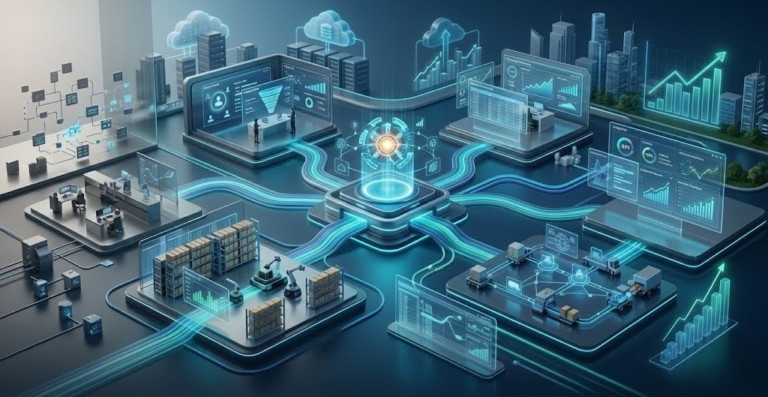
Operations, sales, marketing, and e-commerce are all connected into a single system via an integrated ERP CRM platform, which boosts output and profitability.
Businesses can confidently scale their operations, improve customer interactions, and minimise costly errors with automation, real-time information, and seamless interfaces.
It’s time to deploy a strong ERP CRM system if your company is prepared to improve customer interaction, optimise operations, and open up new growth prospects.
Make an appointment with our professionals right now to learn how the appropriate technology may improve your company’s operations and hasten your expansion.
1. What is ERP and CRM?
ERP is a system that oversees key corporate functions like supply chain management, manufacturing, finance, and inventories. CRM is a system that aids companies in tracking sales activity, managing customer connections, and enhancing marketing and customer support.
2. What are the 4 types of CRM?
Operational CRM, analytical CRM, collaborative CRM, and strategic CRM are the four categories of CRM. These kinds assist companies in managing consumer contacts, analysing consumer data, and enhancing their marketing, sales, and customer service procedures.
3. Does ERP have a CRM?
Indeed, a lot of ERP systems come with an integrated CRM module that enables companies to handle client information, sales activity, and communication all on one platform. Businesses can link operations, orders, and customer connections in a single, centralised system thanks to this connectivity.
4. What are the top 5 CRM tools?
Salesforce, HubSpot CRM, Zoho CRM, Microsoft Dynamics 365, and Pipedrive are a few of the best CRM programs. These platforms assist companies in tracking sales funnels, automating marketing, managing client connections, and enhancing customer support.
5. What are the 4 pillars of CRM?
CRM is built on four pillars: people, process, technology, and data. Together, these pillars assist companies in managing client connections, enhancing communication, and providing superior customer experiences.
6. What are CRM tools?
CRM solutions are software programs that assist companies in tracking interactions, managing customer data, and strengthening client connections. Through information organization and communication process automation, they assist sales, marketing, and customer service.







 Get Started