








If you run a wholesale or distribution business, you already know the margin pressure is relentless. Customers want faster fulfillment, suppliers want tighter lead times, and your operations team is somehow expected to do more with less. Meanwhile, orders are tracked in spreadsheets, inventory numbers never match what’s actually in the warehouse, and your finance team spends three days closing the books every month.
This is the reality for thousands of distributors operating without a modern ERP system – and it’s costing them more than they realize.
ERP ROI is not a concept reserved for Fortune 500 manufacturers. For mid-sized wholesalers and distributors, an ERP system can be the single biggest operational lever available. According to a 2025 industry study, businesses that implement a purpose-built ERP reduce operational costs by up to 23%, cut administrative overhead by 22%, and recover their full investment in as little as 16 months. [Nucleus Research, 2025] The headline claim of 30% is very real – but it comes from targeting the right cost centers: IT consolidation, inventory waste, manual labor, and warehouse inefficiency.
This guide breaks down exactly where those savings come from, how to calculate what they mean for your business, and what a realistic implementation path looks like for a distribution operation.
Why Traditional Distribution Operations Leak Money
Before discussing ERP ROI, it’s worth understanding precisely where costs accumulate without one. Distribution businesses have a unique problem profile compared to manufacturers or retailers. You’re managing high SKU counts, multiple suppliers, variable lead times, customer-specific pricing, and a warehouse that never stops moving – all simultaneously.
- Inventory losses from inaccurate stock data are one of the largest silent costs in distribution. When your inventory records are off – even by 5% – the downstream effects are severe. You overorder to compensate for uncertainty, which ties up working capital. You underorder in the wrong categories and trigger stockouts that damage customer relationships. Businesses using ERP-connected inventory management reduced inventory costs by 22% by improving forecasting accuracy and enabling real-time visibility into stock levels. [Aberdeen Group, “ERP in 2024: Adoption Trends and Business Benefits”] For a distributor moving $10 million in inventory annually, that is $2.2 million in recovered capital.
- Warehouse inefficiency is the second major drain. When pick-and-pack workflows are manual, when staff are walking inefficient routes through the warehouse, when receiving and shipping aren’t coordinated with live order data – labor hours disappear fast. Warehouse labor accounts for 50–70% of total warehouse operating costs, and much of that labor is spent on non-value-added activities like searching for items, correcting pick errors, and re-entering data that already exists somewhere in another system. [Warehouse Education and Research Council (WERC), Distribution Center Metrics Report]
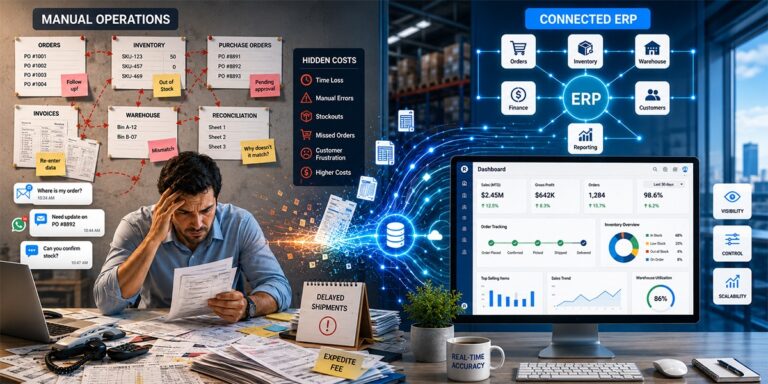
- Manual operations carry a compounding cost that most businesses underestimate. When sales orders come in by email, get manually entered into one system, then re-keyed into an accounting platform, then referenced again when shipping labels are printed – every touchpoint is an opportunity for error and a drain on employee time. For a distributor processing 200 orders per day, eliminating manual re-entry alone can save hundreds of staff hours per week.
- Stockouts and delayed fulfillment are the customer-facing symptoms of all these back-end problems. The average stockout costs a retailer 4% of sales. [Harvard Business Review, “Want to Fix Your Supply Chain? Define the Problem First”] For distributors, the math is even more punishing – a stockout doesn’t just lose you the sale, it can push a B2B buyer to a competitor permanently.

What ERP ROI Actually Looks Like in Distribution
The phrase “ERP ROI” gets thrown around a lot in software marketing, so let’s be precise about what it means and where it comes from in a distribution context.
ROI is calculated as: (Total Benefits – Total Costs) ÷ Total Costs × 100
For a mid-sized distributor investing $350,000 in an ERP implementation and realizing $600,000 in measurable benefits over five years, that’s a 71% ROI. Nucleus Research has documented that companies implementing modern cloud ERP achieved a positive return in just 16 months with a 200% ROI on average. [Nucleus Research, Cloud ERP ROI Guidebook, 2024]
Here are the six specific places where ERP ROI materializes in wholesale and distribution:
- Inventory Carrying Cost Reduction
Real-time inventory visibility is the cornerstone benefit. When your ERP is connected to your warehouse management, purchasing, and sales modules, you stop making inventory decisions based on yesterday’s data. Reorder points trigger automatically. Safety stock is calculated based on actual velocity, not gut feel. Seasonal demand patterns inform forward purchasing. Distributors consistently report 20–38% reductions in inventory carrying costs after ERP implementation. [Procuzy ERP Case Studies, 2025; Anchor Group Distribution Benchmarking]
- Labor Cost Savings Through Automation
ERP ROI in distribution is significantly driven by what happens when repetitive manual tasks are automated. Order acknowledgment emails, invoice generation, purchase order creation, shipping carrier selection, back-order notifications – all of these can be handled by workflow rules in a modern ERP. A $50 million distributor can realize between $75,000 and $180,000 in annual labor efficiency gains just from process automation. [Anchor Group, “Custom ERP Workflow ROI Statistics,” 2026]
- Reduced IT Costs from System Consolidation
Many distributors operate a patchwork of disconnected software: one system for accounting, another for inventory, a separate WMS, a CRM, and a handful of spreadsheets tying them together. Consolidating onto a single ERP platform eliminates redundant licensing fees, reduces IT maintenance burden, and removes integration costs. This consolidation delivers a 30% reduction in IT costs. [Software Path, ERP Industry Report, 2024] This is where the headline “30% cost reduction” number most consistently holds up in real-world data.
- Reporting Automation and Decision Speed
Without a connected ERP, producing a meaningful business performance report means pulling data from five different systems, reconciling discrepancies, and hoping the numbers are current. Reporting automation changes this entirely. Finance can close the books faster – modern ERP adopters cut financial close time by 50% on average. [Gartner, “Advanced ERPs Could Cut Financial Close Times by 30%,” CFO Dive, 2026] Operations managers get live dashboards showing fill rates, order accuracy, carrier performance, and warehouse productivity.
- Reduction in Fulfillment Errors
Order accuracy is a direct revenue protection measure. Each incorrect shipment creates a return, a credit, a customer service interaction, and often a damaged relationship. ERP-integrated order management, with barcode scanning and automated picking validation, pushes order accuracy to above 99% in most documented implementations. [Anchor Group, “Custom ERP Workflow ROI Statistics,” 2026] For a distributor shipping 500 orders per day, dropping error rates from 3% to under 1% means eliminating 10+ problem shipments daily.
- Supplier and Purchase Order Efficiency
The purchasing side of distribution is where significant ERP ROI is often overlooked. Automated purchase orders triggered by reorder points, supplier performance tracking built into the system, and three-way invoice matching together eliminate overpayment, prevent duplicate orders, and dramatically reduce the accounts payable workload. One documented ERP implementation saw PO approval speed increase by 3x and AP staffing reduced from 7 to 2.5 people. [Rand Group, “What Is the Average ROI of an ERP Implementation?,” 2025 – citing Conquest Completion Services / Microsoft Dynamics 365 case study]

The Real Numbers: ERP ROI Calculation for a Mid-Size Distributor
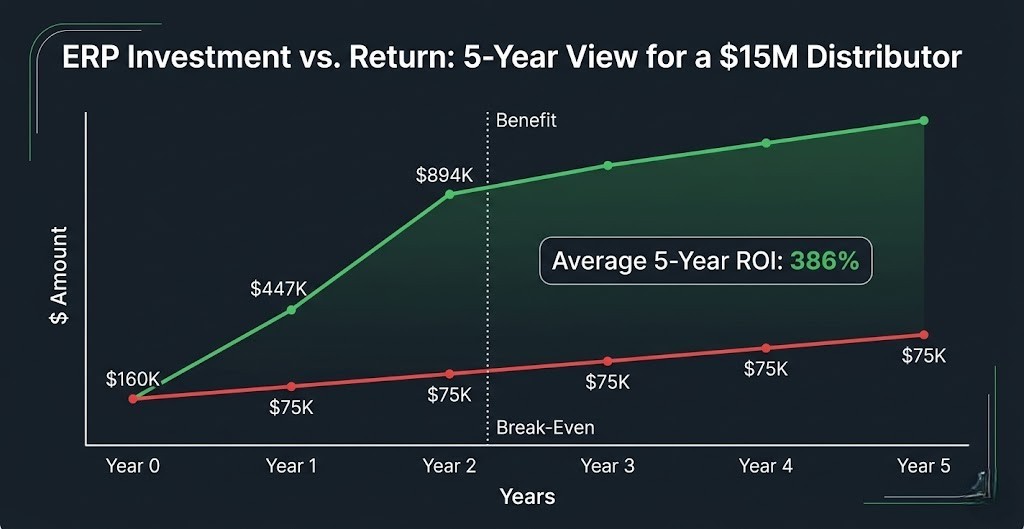
Let’s move beyond averages and run a concrete ERP ROI scenario for a distribution business with $15 million in annual revenue.
Baseline Assumptions:
- Annual inventory value: $4 million
- Annual warehouse labor: $1.2 million
- Annual IT software costs (multiple systems): $180,000
- Monthly order volume: 4,000 orders
- Current order error rate: 2.5%
- Monthly manual admin hours (data entry, reporting): 320 hours
Year 1 Implementation Costs:
- Software licensing (cloud ERP): $60,000/year
- Implementation & onboarding: $85,000 (one-time)
- Training: $15,000 (one-time)
- Total Year 1 Cost: $160,000
Annual Benefits (Conservative Estimates):
- Inventory carrying cost reduction (20%): $160,000
- Labor efficiency gains (12% reduction): $144,000
- IT consolidation savings (25% reduction): $45,000
- Order error reduction (2.5% → 0.8%): $38,000
- Reporting time savings (320 hrs/mo → 120 hrs/mo at $25/hr): $60,000
- Total Annual Benefit: $447,000
5-Year ROI Calculation:
- Total 5-year benefits: $2,235,000
- Total 5-year costs: $460,000 (Year 1 + 4 years of licensing)
- Net ROI: 386%
- Payback period: ~5 months into Year 1
These are conservative estimates. Businesses that execute ERP implementation well – with strong change management and clean data migration – regularly outperform this model. 83% of organizations that performed pre-implementation ROI analysis went on to meet or exceed their financial projections. [Panorama Consulting Group, ERP Report, 2023]
Addressing the Cost Side: What Distribution ERP Implementation Actually Costs
Understanding ERP ROI requires being honest about both sides of the equation. Implementation costs are real, and they vary significantly.
- Cloud ERP (SaaS model) is the most common choice for mid-market distributors today and carries the most favorable total cost of ownership. Monthly subscription fees typically run $40–$200 per user for established platforms. [Zconsulto, “ERP Implementation Cost Breakdown,” 2026] Cloud ERP deployments deliver 4x the ROI of legacy on-premise solutions over a five-year horizon. [Rand Group, citing Nucleus Research ROI Framework, 2025]
- Implementation services are often where costs exceed initial estimates. Data migration, custom workflows, integrations with existing systems (carriers, supplier portals, customer EDI connections), and user training all add to the project cost. A realistic budget for a 20–50 user distribution ERP ranges from $75,000 to $200,000 in services, on top of licensing.
- The hidden cost most distributors underestimate is change management. Research consistently identifies poor change management and incomplete data preparation as the primary reasons ERP projects fail to achieve their projected ERP ROI. [Rand Group, “What Is the Average ROI of an ERP Implementation?,” 2025] Budgeting for proper team training, process documentation, and a phased rollout is not optional – it’s the difference between realizing 200% ROI and realizing 40%.
- Long-term savings, however, decisively outweigh these upfront costs for most distributors. Beyond the operational efficiencies already discussed, there is a strategic dimension to ERP that compounds over time: the ability to onboard new customers without proportionally adding headcount, to expand to new distribution locations on the same platform, and to use real operational data to negotiate better supplier terms.
Employee Productivity: The Underrated ROI Driver
Most ERP ROI discussions focus on hard cost savings – inventory, labor, IT. But employee productivity gains are a major component that often tips the total return calculation decisively.
ERP implementation leads to a 20% increase in overall employee productivity. [Forrester Research, “The Future of ERP: Trends and Market Analysis,” 2024] In a distribution context, this shows up in several specific ways:
- Warehouse staff stop spending time on manual counts and paper-based processes and shift to scan-and-verify workflows. Pick rates improve. Receiving accuracy improves. Shift throughput increases without adding headcount.
- Sales and customer service teams gain access to real-time inventory, order status, and customer account history from a single screen. The time spent digging through systems to answer a customer question drops from 8 minutes to under 60 seconds.
- Finance and accounting teams experience the most dramatic productivity transformation. Month-end close, which might take 5-7 working days with disconnected systems, drops to 1–2 days with an integrated ERP. 78% of organizations reported measurably improved productivity across departments after ERP implementation. [Zconsulto, “Key Metrics to Measure ERP ROI,” 2025]
- Management and ownership gain the reporting visibility they’ve been lacking. Instead of waiting for a manually assembled weekly report that’s already outdated, leadership can access live dashboards showing margin by product line, fill rate by customer, inventory turns by SKU, and sales performance by territory – all from a mobile device.
Common Mistakes That Kill ERP ROI for Distributors
- Going live with dirty data is the single most common ERP killer. If your item master, customer records, and vendor files are inconsistent before migration, every downstream process inherits that inconsistency. Dedicate 60–90 days to data cleansing before go-live.
- Skipping process redesign means you’ve spent significant money to automate bad processes. ERP implementation is the ideal moment to examine your workflows critically and redesign them before automating them. Too many distributors map their existing broken processes into the new system and then wonder why it doesn’t deliver the promised ERP ROI.
- Under-investing in training is a false economy. A system that staff don’t use properly delivers a fraction of its potential value. Budget for structured training, designate internal champions per department, and plan for ongoing refresher sessions as the system evolves.
- Treating go-live as the finish line is a mindset error. The real value of an ERP accrues over the 12–36 months following go-live, as users become proficient, reporting becomes more sophisticated, and integrations with suppliers and customers deepen. Plan for a post-implementation optimization phase with the same seriousness as the implementation itself. [Panorama Consulting Group, ERP Report, 2023]
How to Build Your Own ERP ROI Case
If you’re building an internal justification for an ERP investment, here is a practical framework specific to distribution:
Step 1 – Quantify your current pain. Document actual costs: inventory carrying costs, return/error rates, hours spent on manual data entry, IT licensing spend across all current systems, average time to close monthly books.
Step 2 – Apply conservative improvement percentages. Use the lower bounds of industry benchmarks: 15% inventory reduction, 10% labor efficiency gain, 20% IT cost reduction, 50% error reduction. [Panorama Consulting Group; Aberdeen Group; Software Path – as cited throughout]
Step 3 – Model a realistic implementation cost. Get at least two vendor quotes for software and implementation. Add 20% contingency for data migration and training.
Step 4 – Build a 3-year and 5-year view. Year 1 is your investment year. Years 2–5 are where ERP ROI compounds. Show both payback period and total return.Step 5 – Include strategic value. The ability to scale without proportional headcount growth is worth quantifying. If your business is growing 15% annually and you can absorb that growth without adding two warehouse staff members, that has real dollar value.

The Long-Term Savings Picture
Beyond the first-year metrics and the 5-year ROI model, there is a longer-term strategic reality for distributors who invest in ERP early: the competitive gap widens over time.
Distributors operating on modern ERP platforms can onboard a new customer in hours, not days. They can offer real-time order tracking via customer portals. They can process EDI orders automatically. They can respond to supply chain disruptions faster because their data is live. They can analyze which customer relationships are profitable and which are not – at the SKU level.
Their competitors operating on legacy systems or spreadsheets are still reconciling last week’s inventory. The operational advantage compounds annually, and it ultimately becomes a customer retention and acquisition advantage.
Long-term savings also come from avoiding the crisis costs that plague under-invested distribution operations: emergency procurement to cover a stockout, expedited shipping charges to recover from a delayed fulfillment, the overtime costs of compensating for a broken process with raw labor, and eventually the cost of losing a major account because your service reliability couldn’t match a better-equipped competitor.
Modern cloud ERP adopters achieve a 200% average ROI, but the top-quartile performers – those who invest in change management, proper data preparation, and ongoing optimization – routinely report ROI exceeding 300%. [Nucleus Research, Cloud ERP ROI Guidebook, 2024] Organizations that modernize to composable, cloud-based ERP architecture realize up to 30% faster time-to-value and 20% higher process efficiency compared to those maintaining legacy systems. [Gartner, “ERP Value Study,” 2024 – as cited by Rand Group]
The question for most distribution operators isn’t really whether ERP ROI justifies the investment. The real question is how much operational cost and competitive ground you’re prepared to keep losing before you make the move.
- What is the average ROI for ERP implementation?
According to Nucleus Research, modern cloud ERP implementations achieve an average ROI of around 200% over time. Most businesses recover their ERP investment within approximately 16 months through automation and operational efficiency gains.
- Is a 3% ROI good?
A 3% ROI is generally considered very low for an ERP investment because ERP projects usually target long-term operational and productivity gains. Most successful ERP implementations aim for ROI ranges above 50% and often exceed 100–200% over several years.
- What does 7% ROI mean?
A 7% ROI means the investment generated a return equal to 7% of the original investment cost.
For example, if a business invests ₹10 lakh and earns ₹70,000 in net profit or savings, the ROI is 7%.
- What is ERP return?
ERP return refers to the financial and operational benefits a business gains after implementing an ERP system. It includes cost savings, improved productivity, faster processes, better inventory control, and increased operational efficiency.
- What is ERP ROI?
ERP ROI (Return on Investment) measures how much value or profit a business gains compared to the total cost of implementing an ERP system. It is calculated by comparing ERP benefits like cost savings and efficiency improvements against implementation and operating costs.

 Get Started