







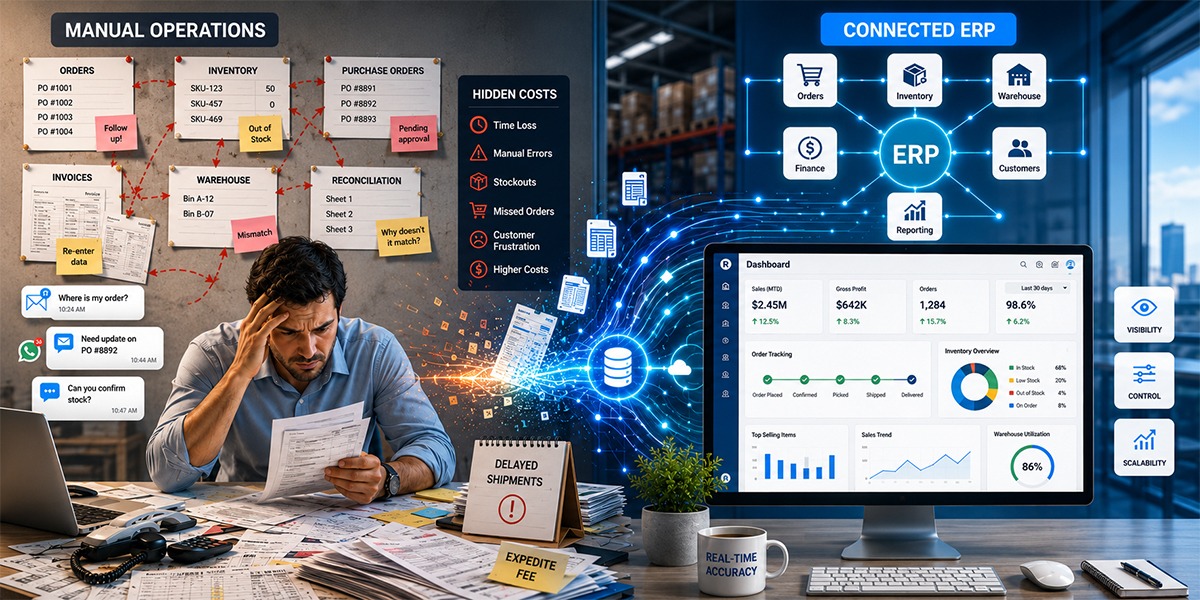
If you are running a wholesale or distribution business today, you already know the feeling. A buyer calls to check on a shipment, and someone has to dig through a spreadsheet to find the answer. A returned order sits in a gray zone because the system for returns is a shared inbox and a sticky note. A new sales rep joins and spends their first two weeks just learning where everything lives. Meanwhile, your most experienced warehouse staff are the only ones who actually know which bin a slow-moving SKU ended up in after the last reorganization.
These are not edge cases. They are the daily reality for thousands of wholesalers and distributors still running on disconnected tools, manual processes, and institutional knowledge that walks out the door whenever someone leaves. And the uncomfortable truth is that what worked at a smaller scale eventually becomes the ceiling that prevents you from growing to the next one.
This is exactly why the conversation around retail ERP has shifted from “something large enterprises do” to “something every serious distribution business needs.” The pressure to modernize is no longer theoretical. It shows up in order volumes you cannot process fast enough, in customers who expect real-time stock visibility, and in margins getting squeezed from every direction. The businesses responding to that pressure — by implementing a proper retail ERP — are not just surviving the shift. They are pulling ahead.
This guide breaks down what is actually driving that transition, what manual operations are truly costing you, and what to realistically expect when you move to a system built for how distribution actually works in practice.
The Hidden Cost of Running on Manual Operations
The phrase “manual operations” sounds modest, almost quaint. The reality is far more expensive.
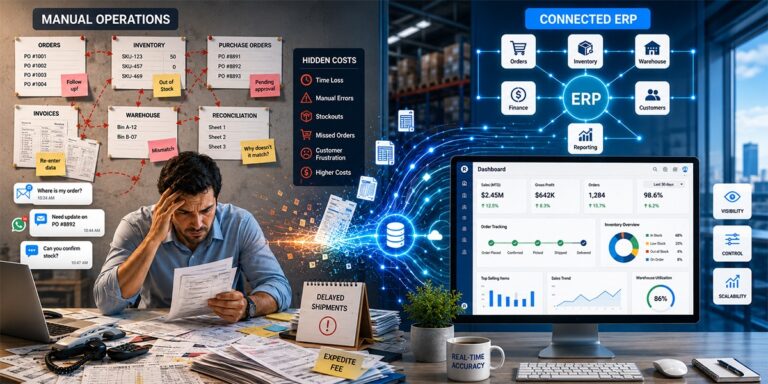
For a wholesale or distribution business, manual operations typically mean order entry happening through phone calls, emails, or messaging apps that then get manually keyed into a spreadsheet or a standalone billing tool. Inventory exists in someone’s head or in a shared file that is always slightly out of date. Purchase orders are created in one place, invoices in another, and reconciliation happens at month end — when the damage is already done and reversing it takes more time than preventing it would have.
The direct costs are measurable. Mis-shipments because stock counts were wrong. Lost orders because a message fell through the gap between a salesperson’s phone and the back office. Overstocking in one warehouse and stockouts in another because purchasing decisions were made without a consolidated view. Duplicated data entry that eats hours every week and still produces errors. Customer credits that get issued twice because the original was recorded on a piece of paper no one could find.
The indirect costs are harder to measure but just as real. Customers who stop reordering because your fulfillment is unpredictable. Sales reps who spend more time on admin than on selling. Owners who cannot take a day off because too much operational knowledge lives only in their heads. Finance teams that spend the last week of every month reconstructing what actually happened instead of planning what comes next. These are the things that cap a distribution business at a certain size, no matter how strong the product or the relationships are.
A properly implemented retail ERP addresses all of this at the infrastructure level — not with workarounds. That is the fundamental difference between patching a broken system and actually replacing it with something built for the job.
What Has Changed: Why Manual Processes That Worked Before No Longer Do?
There is a version of this story where manual operations worked fine. If you were running a regional distribution business ten years ago — with a contained product catalog, a stable customer base that placed predictable orders, and a straightforward logistics operation — you could manage on spreadsheets and phone calls. The ecosystem was simpler, the expectations were lower, and the pace was slower.
None of those conditions hold today.
Retail buyers now expect the same visibility into their wholesale orders that consumers expect from online shopping. They want to know if something is in stock before they commit to an order. They want confirmation immediately, not the following morning. They want to track their shipment without having to call someone. They want self-service access to invoices, order history, and delivery status. If your business cannot deliver that experience, competitors who can will take those accounts — and in most categories, those competitors exist and are already equipped to serve them.
Product catalogs that distribution businesses manage have also grown dramatically — more SKUs, more variants, more pricing tiers for different customer segments, more promotional structures. Managing that complexity in spreadsheets is not just inefficient; it is a constant source of error. A pricing update that does not make it into every relevant document, a discontinued SKU that still appears in a catalog someone emailed last month, a promotional tier that applies to some customers but not others — all of these create problems that consume time and damage relationships.
Regulatory requirements have added another layer that simply did not exist at the same level a decade ago. GST compliance, e-invoicing mandates, e-way bill generation, TDS on payments — the compliance burden for a distribution business operating across multiple states has grown significantly. Manual processes cannot reliably handle that complexity at scale without dedicated compliance staff and significant ongoing legal and financial risk. A missed e-way bill on a high-value inter-state shipment, or an invoice that does not meet current format requirements, can create downstream problems that take weeks to resolve.
Businesses that invest in a modern retail ERP handle all of these layers in one integrated place, which is why so many are making the switch now rather than waiting until the problems become unmanageable.
What a Retail ERP Actually Does for Wholesalers and Distributors?
The term retail ERP can mean different things in different contexts, so it is worth being specific about what it means for a wholesale and distribution operation.
At its core, a retail ERP for distribution connects every part of the order lifecycle in a single system. A buyer places an order — through a portal, through a sales rep, or through an EDI integration — and that order immediately flows into inventory, logistics, invoicing, and reporting without anyone having to re-enter data anywhere. Stock levels update in real time. The warehouse team gets a pick list. The finance team gets a payable. The sales rep can see order status without calling the warehouse.
That sounds simple. The operational impact is not.
When inventory is managed through a retail ERP, you are working from a single source of truth across all locations and all channels. If a customer asks whether a product is available for delivery next Tuesday, the answer is not “let me check and get back to you.” It is an immediate, accurate answer from live data. That kind of responsiveness is not just convenient — it is what retains customers in a market where alternatives exist.
Pricing and discount management replaces the tangle of manually maintained spreadsheets with rules that apply automatically. Customer-specific pricing, volume discounts, promotional tiers, tax calculations — all of it is built into the system and applies consistently every time, without someone having to remember which customer gets which rate.
For businesses operating across multiple warehouses or fulfilment points, a retail ERP provides consolidated visibility that is simply impossible to achieve manually. You can see total stock across all locations, allocate inventory based on order origin and shipping costs, and make purchasing decisions based on real consumption data rather than gut feel. The reduction in both overstock and stockout situations that businesses typically see after going live on a retail ERP is often significant enough to recover the implementation cost relatively quickly.
The Inventory Problem: Where Manual Operations Break Down First?
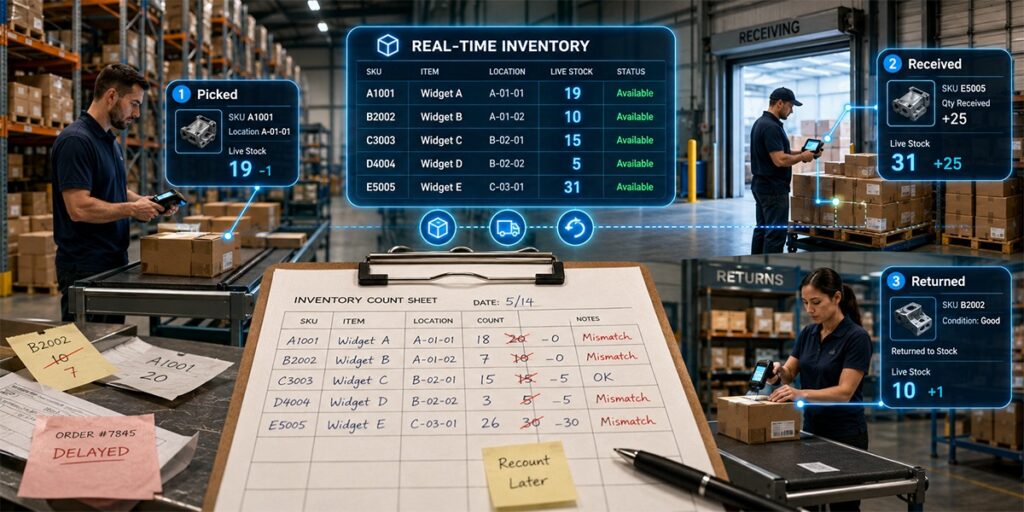
Inventory is the center of gravity for any distribution business. Everything else — purchasing, fulfillment, cash flow, customer relationships — depends on having accurate, current inventory data. And inventory is precisely where manual operations fail first and most visibly.
The core problem is that manual inventory tracking is always historical. By the time a spreadsheet is updated, the reality on the warehouse floor has already moved on. Goods have been picked. New stock has arrived. A return has come back. When decisions are made on inventory data that is even a few hours old, errors compound. Orders get promised that cannot be fulfilled. Purchasing happens for stock that is already sitting in a secondary location. Returns end up in physical limbo that only surfaces as a discrepancy at the next count.
A retail ERP solves this by making inventory updates happen at the transaction level, in real time, automatically. When an order is picked, inventory decreases immediately. When a purchase order is received, inventory updates at the moment of receiving — not at the end of the week when someone finally gets to the paperwork. When a return is processed, inventory returns to the appropriate location and status without manual reconciliation.
This real-time accuracy has downstream effects on nearly every other part of the business. Purchasing becomes data-driven rather than intuition-driven. Customer service becomes responsive rather than reactive. Cash flow planning becomes more accurate because you know precisely what you have, what is on order, and what you need to buy. The operations team stops spending time on reconciliation and starts spending it on improvement.
For businesses that have grown to the point where a physical inventory count is a multi-day operation that disrupts normal workflows, the transition to real-time inventory management is often described as transformative rather than incremental. The operational confidence that comes from knowing your numbers are current has a value that is hard to quantify but immediately noticeable — in fewer escalated customer calls, in purchasing decisions that do not result in warehoused overstock, and in a finance function that is working from reliable data rather than best estimates.
Order Management at Scale: How the Equation Changes
For a distribution business handling high order volumes, the order management process is where operational efficiency either compounds or collapses. Manual order management — receiving an order, checking stock, confirming with the customer, routing to the warehouse, generating a delivery note, creating an invoice — has a ceiling. Beyond a certain volume, either quality degrades or headcount must increase proportionally.
Implementing a retail ERP breaks that ceiling by automating the routine steps in the order management workflow. Order acknowledgment, stock reservation, delivery note generation, invoice creation — these happen as part of the system flow, not as individual human tasks that each carry the risk of error or delay. Your team can focus on exceptions, on customer relationships, and on resolving situations that genuinely require judgment — rather than on data entry the system can handle more accurately in a fraction of the time.
For businesses with multiple sales channels — field sales reps taking orders, an online B2B portal, EDI connections with large retail customers — the system provides a single order management layer that handles all channels without creating separate workflows or reconciliation headaches. An order is an order, regardless of where it came from, and it flows through the same process with the same accuracy.
The visibility this creates for everyone on the team is itself a significant operational improvement. Sales reps can see order status without calling the warehouse. Warehouse teams can see upcoming orders and plan picking routes accordingly. Finance can see what has shipped, what has been invoiced, and what is outstanding without manual compilation. Customer service can answer questions on the first call rather than putting people on hold to find out. That shared visibility reduces the internal friction that consumes enormous amounts of time in businesses where information lives in silos — and it builds the kind of organizational confidence that lets teams handle higher volumes without proportionally higher headcount.
Compliance, Invoicing, and the Regulatory Layer
For wholesale and distribution businesses operating at any significant scale, compliance is not optional and it is not simple. GST-compliant invoicing, e-way bill generation for inter-state shipments, TDS management, reconciliation with government portals — these requirements carry real consequences when they are not met correctly.
Manual compliance management means someone is responsible for ensuring that every invoice meets current format requirements, that every qualifying shipment has a valid e-way bill, and that every monthly reconciliation matches what has been reported to the relevant authority. That work is time-consuming, error-prone, and dependent on individuals who may leave or make mistakes.
A retail ERP designed for the Indian distribution context handles compliance as a built-in function rather than an afterthought. Invoices are generated in the correct GST format automatically. E-way bills can be generated from the system without manual intervention. The data required for monthly and quarterly filings is available in the correct format without hours of compilation. For a distribution business that has struggled with compliance backlogs or audit exposure, this capability alone can justify the decision to implement a modern system.
Choosing the Right Solution: What Distribution Businesses Should Evaluate?
Not all retail ERP systems are built with wholesale and distribution workflows in mind. Many platforms that use the term ERP are primarily designed for retail or manufacturing and have adapted incompletely to distribution requirements. Evaluating a solution for a distribution context requires asking specific questions.
Does the system handle multi-warehouse inventory natively, with the ability to allocate orders to specific locations based on configured rules? Does it support the pricing complexity that distribution businesses require — customer-specific pricing, volume tiers, promotional pricing with date-based rules? Does it include a genuine B2B order portal that allows customers to place and track orders without phone or email? Does it handle the specific compliance requirements of your operating context, including GST, e-invoicing, and e-way bills? And critically, does the vendor have a track record of implementations in distribution businesses similar in size and structure to yours?
Beyond functionality, the implementation approach matters enormously. A retail ERP is not software you simply turn on — it is a system that requires your business processes to be mapped, your data to be migrated, and your team to be trained. Configuration decisions made early in the implementation have long-lasting effects on how well the system serves you. The quality of implementation support and the availability of ongoing customer success resources often determines whether an implementation succeeds or struggles.
The businesses that see the most significant results are typically those that approached selection as a business transformation project rather than a software purchase. The right system, implemented well, changes how the business operates — not just which tool people use to perform the same tasks they were performing before. That distinction matters, because technology alone does not produce better operations. Thoughtfully redesigned processes, supported by the right technology, do.
The Transition: What to Expect When You Move Away from Manual Operations?
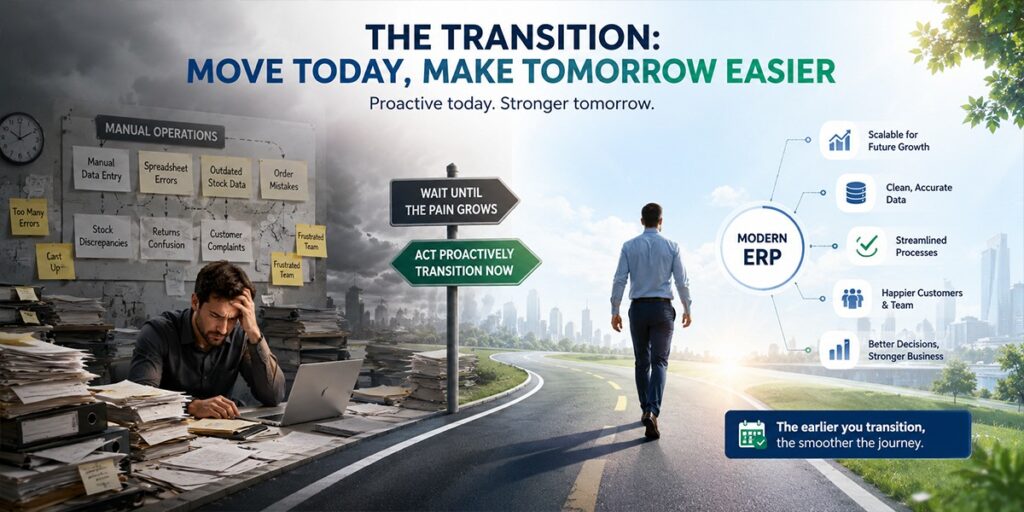
The most common hesitation about implementing a new system comes down to transition anxiety. The business is running. Orders are being fulfilled. Customers are reasonably happy. The disruption of a system change feels like a risk the current pain does not justify.
That calculation misses something important. The businesses that wait for the pain to become severe enough before acting typically make the transition under worse conditions — under more volume pressure, with more complex data to migrate, with more entrenched manual habits to change. A business managing 300 orders a day has a harder time absorbing a go-live than one managing 100. The distribution businesses that move proactively, when they have the operational bandwidth to do it thoughtfully, almost universally describe it as the right call in retrospect.
A well-planned retail ERP implementation typically runs in phases. Data migration — products, customers, pricing, opening balances — is completed and verified before the system goes live. Key workflows are configured and tested with real scenarios. A training period runs parallel to the existing system so the team builds confidence before the cutover. The go-live itself is a transition, not a cliff.
The first weeks after going live are typically the most intensive. New workflows have to become habitual. Edge cases that were not covered in training emerge and get resolved. Questions that seemed theoretical during training become real problems that need real answers. The team moves from the comfort of the familiar to the capability of the new, and that shift takes time and support. For distribution businesses that manage this transition well, the operational difference is noticeable within the first month — faster order processing, more accurate inventory, cleaner invoicing, and better visibility for everyone on the team.
The Window for Competitive Advantage Is Open Now
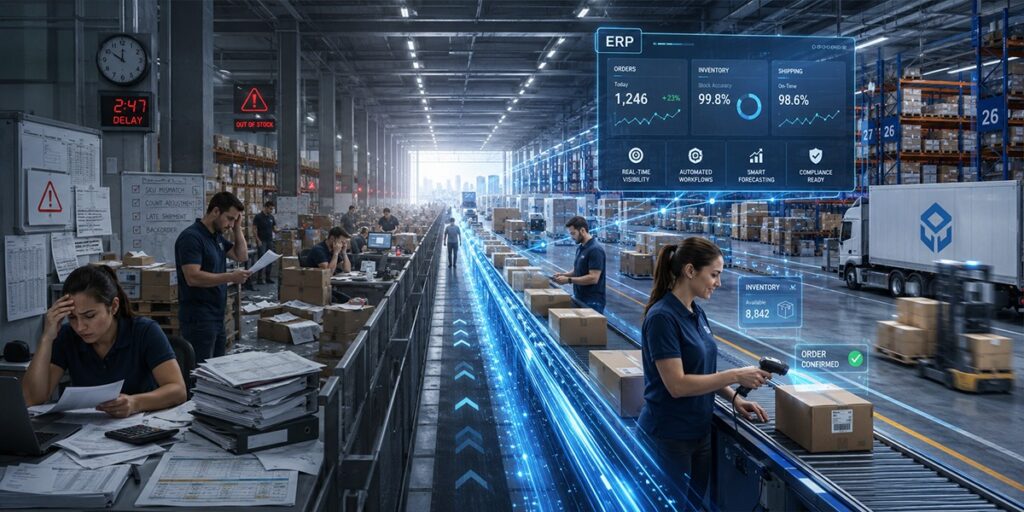
The distribution businesses implementing a retail ERP today are building operational advantages that compound over time. Every month of running on accurate, real-time data produces better purchasing decisions, better customer service, and better financial clarity. Every month of automated compliance reduces the risk and cost of regulatory exposure. Every month of streamlined order management creates capacity that can be redirected from administration to growth.
The businesses still running on spreadsheets and disconnected tools are not standing still. They are falling behind — gradually but consistently — relative to competitors who have invested in operational infrastructure. The gap widens with every order cycle, every inventory count, every compliance filing. At a certain point, the gap becomes visible to customers who notice that one supplier can give them a real-time answer and another one has to call back.
The question for wholesalers and distributors considering this move is not whether the transition will eventually become necessary. It will. The question is whether you make that transition on your terms, with the time and focus to do it right — or under the pressure of operational problems that have grown too large to ignore. The businesses that move before they are forced to almost always execute better, experience less disruption, and realize the benefits sooner.
The window for doing it right is open now. The businesses that walk through it will be better positioned for whatever the market brings next.
FAQs
- What is retail ERP?
A retail ERP is an integrated software system that connects all business operations — inventory, orders, invoicing, and compliance; into one platform. It eliminates manual processes and gives wholesalers and distributors real-time visibility across their entire business.
- What is the best ERP for retail?
The best ERP for retail depends on your business size, workflows, and compliance needs — popular options include SAP, Microsoft Dynamics, and purpose-built solutions for Indian distributors. The right choice is one that natively handles your pricing complexity, multi-warehouse inventory, GST compliance, and B2B order management.
- Is Oracle retail an ERP?
Yes, Oracle Retail is an ERP suite designed specifically for retail businesses, covering merchandising, inventory, supply chain, and financials. It is built for large-scale retail operations and integrates multiple business functions into a single platform.
- What are the 7 types of retailers?
The 7 types of retailers are department stores, supermarkets, specialty stores, convenience stores, discount stores, online retailers, and warehouse/club stores. Each serves different customer needs through distinct pricing, product range, and shopping experience strategies.
- What are the 4 pillars of ERP?
The 4 pillars of ERP are finance, human resources, supply chain/operations, and customer relationship management. Together they unify core business functions into a single system for streamlined data flow and decision-making.
 Get Started